Advertisements
Advertisements
प्रश्न
Choose the correct alternative and rewrite the following sentence.
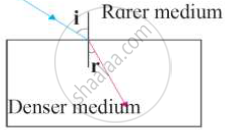
A ray of light strikes the glass slab at an angle of 50°. What is the angle of incidence?
पर्याय
50°
90°
60°
40°
Advertisements
उत्तर
40°
The ray of light strikes at an angle of 50 with the horizontal. The angle of incidence is with respect to the normal, so the angle of incidence is 90° − 50° = 40°.
APPEARS IN
संबंधित प्रश्न
Explain how the formation of a rainbow occurs.
On the basis of the experiment, "To trace the path of a ray of light through a rectangular glass slab", students of a class arrived at which one of the following conclusions?
(A) Angle of incidence is greater than the angle of emergence.
(B) Angle of emergence is smaller than the angle of refraction.
(C) Emergent ray is parallel to the refracted ray.
(D) Incident ray and emergent ray are parallel to each other.
Explain the term absolute refractive index of a medium and write an expression to relate it with the speed of light in vacuum.
Name a prism required for obtaining a spectrum of Ultraviolet light.
Which of the above wavelengths has a higher frequency?
The following diagram shows a 60°, 30°, 90° glass prism of critical angle 42°, Copy the diagram and complete the path of incident ray AB emerging out of the prism marking the angle of incidence on each surface.

How can you bend light away from the normal?
Draw diagrams to show the refraction of light from glass to air. In diagram, label the incident ray, refracted ray, the angle of incidence (i) and the angle of refraction (r).
The critical angle for glass-air is 45° for the light of yellow colour. State whether it will be less than, equal to, or more than 45° for (i) ref light, (ii) blue light?
The refractive index of air with respect to glass is expressed as `""_g μ_a=sin i /sin r`.
- Write down a similar expression for aμg in terms of the angles i and r.
- If angle r = 90°, what is the corresponding angle i called?
- What is the physical significance of the angle i in part (b)?
A student has traced the path of a ray of light through a glass slab as follows. If you are asked to label 1, 2, 3 and 4, the correct sequencing of labeling ∠i, ∠e, ∠r and lateral displacement respectively is
(a) 2, 1, 3, 4
(b) 1, 2, 3, 4
(c) 1, 3, 2, 4
(d) 1, 3, 4, 2
Select from the following the best set-up for tracing the path of a ray of light through a rectangular glass slab:

(A) I
(B) II
(C) III
(D) IV
A student traces the path of a ray of white light through a rectangular glass slab and marks, the angles of incidence (∠i) , refraction (∠r) and emergence (∠e) as shown. Which angle or angles has he not marked correctly?

(A) ∠i only
(B) ∠i and ∠r
(C) ∠i and ∠e
(D) ∠r and ∠e
While performing the experiment on tracing the path of a ray of light through a rectangular glass slab, in which of the following experimental set-ups is a student likely to get best results? P1 and P2 are the positions of pins fixed by him.
(A) I
(B) II
(C) III
(D) IV
Rahim recorded the following sets of observations while tracing the path of a ray of light passing through a rectangular glass slab for different angles of incidence.
|
S. No. |
Angle of incidence |
Angle of refraction |
Angle of emergence |
|
I |
45° |
41° |
45° |
|
II |
40° |
38° |
38° |
|
III |
45° |
41° |
40° |
|
IV |
41° |
45° |
41° |
The correct observation is recorded at serial number:
(1) I
(2) II
(3) III
(4) IV
Define the term refractive index of a medium. What do you understand by the statement 'the refractive index of glass is 1.5 for white light'?
Fig shows a lens as a combination of a glass block and two prisms.
(i) Name the lens formed by the combination.
(ii) What is the line XX' called?
(iii) Complete the path of the incident ray PQ after passing through the lens.
(iv) The final emergent ray either meets XX' at a point or appears to come from a point on XX'. Label it as F, What is this point called?
Light of a single colour is passed through a liquid having a piece of glass suspended in it. On changing the temperature of liquid, at a particular temperature, the glass piece is not seen.
Why is the light of a single colour used ?
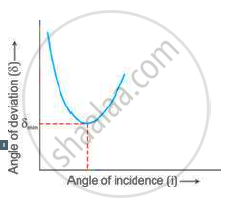
Using the curve, how do you infer that for given prism, the angle of minimum deviation δmin is unique for the given light?
Name the phenomenon responsible in the following case:
Twinkling of stars
Name one main factor on which the direction of bending of a ray of light depends.
Write a relation between the angle of incidence (i), angle of emergence (e), angle of the prism (A), and angle of deviation (d) for a ray of light passing through an equilateral prism.
A glass slab is placed over a page on which the word VIBGYOR is printed with each letter in its corresponding colour.
- Will the image of all the letters be in the same place?
- If not, the state which letter will be raised to the maximum. Give a reason for your answer.
State the relation between the refractive index μ and the velocity of light (vm) in that medium.
Comment on the statement ‘The refractive index of glass is 3/2.’
What is the total reflecting prism?
How does the angle of deviation produced by a prism depend on the colour of light used? Which colour of white light is deviated (i) most, (ii) least, by a prism?
You are provided with a printed piece of paper. Using this paper how will you differentiate between a convex lens and a concave lens?
The refractive index of air with respect to glass is defined: as gµa = sin i/sin r
Write down a similar expression for aµg in terms of angle i and r.
In the diagram below, PQ is a ray of light incident on a rectangular glass block.

How are the angles ‘i’ and ‘e’ related to each other?
A ray of monochromatic light is incident from air into a glass slab. Draw a labelled ray diagram indicating the change in its path till it emerges out of the slab. In the diagram, mark the angle of incidence (i) and the angle of refraction (r) at the first interface. How is the refractive index of glass related to the angles i and r?
Draw ray of light bending towards the normal while passing from glass to water. Label your diagrams.
The figure shows two prisms A and B. A monochromatic ray of light PO is incident at the face of the prism A. Complete the diagram to show the path of the ray till it emerges out of the prism B.

The diagram shows the path of a ray of light through a rectangular glass block placed in a liquid of uniform density.

Show with the help of a ray diagram the path of the ray when incident ray normally falls on the first surface of the glass block and passes through the block and the liquid.
Draw a diagram of a prism and label:
(i) the base,
(ii) the refracting surfaces,
(iii) the refracting edge,
(iv) the refracting angle in it.
The velocity of light in diamond is 121000 kms-1. What is its refractive index?