Advertisements
Advertisements
प्रश्न
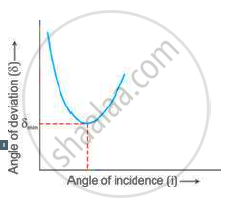
How does the angle of deviation produced by a prism change with increase in the angle of incidence. Draw a curve showing the variation in the angle of deviation with the angle of incidence at a prism surface.
Advertisements
उत्तर १
As the angle of incidence increases, the angle of deviation decreases first and reaches to a minimum value (δm) for a certain angle of incidence. By further increasing the angle of incidence, the angle of deviation is found to increase.
Variation of angle of deviation (δ) with angle of incidence(i):
उत्तर २
The deviation angle first increases with increasing incidence angle and then decreases. From figure,
δ = δ1 + δ2 ....(i)
and i = δ1 +γ1 ; e = δ2 +γ2
⇒ i = γ1 = δ1 ....(ii)
⇒ e - γ1 = δ2 ....(iii)
from ΔON1 N2
γ1 +γ2 + ∠N1 ON2=180° ....(iv)
from cyclic quadrilateral
∠A + ∠N1ON2 = 180° ....(v)
from (iv) and (v)
γ1 +γ2 = A
δ = i - γ1 + e - γ2
=( i - e) - (γ1 + γ2) ...(vi)
at δm ;
i = e ; γ1 = γ2= γ
δm =2i - A ...(vii)
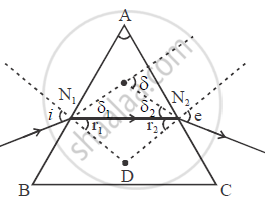
The variation in the angle of deviation with the angle of incidence at a prism surface
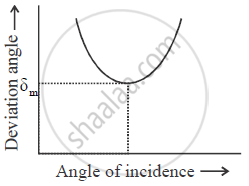
Graph between i and δm
संबंधित प्रश्न
A student very cautiously traces the path of a ray through a glass slab for different values of the angle of incidence (∠i). He then measures the corresponding values of the angle of refraction (∠r) and the angle of emergence (∠e) for every value of the angle of incidence. On analysing these measurements of angles, his conclusion would be
(A) ∠i > ∠r > ∠e
(B) ∠i = ∠e > ∠r
(C) ∠i < ∠r < ∠e
(D) ∠i = ∠e < ∠r
When light travels from a rarer to a denser medium, its speed ______.
The highest refractive index is of ______.
Name the colour of white light which is deviated the most on passing through a prism.
Draw an í- `delta` graph for a mono chromatic raY through a glass prism of a plane and mark
(i) `delta` m, the angle of mínimum devíation
(íí) Any two values of i for which value of `delta` ís same.
Which colour of light travels fastest in any medium except air?
Express the refractive index μ of a medium in terms of the velocity of light.
Two parallel rays of Red and Violet travelling through the air, meet the air-glass boundary as shown in the above figure. Will their paths inside the glass be parallel? Give a reason for your answer.

Consider these indices of refraction: glass: 1.52; air: 1.0003; water: 1.333. Based on the refractive indices of three materials, arrange the speed of light through them in decreasing order.
