Advertisements
Advertisements
Question
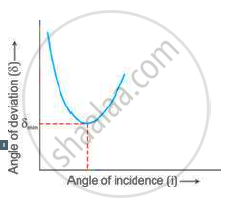
How does the angle of deviation produced by a prism change with increase in the angle of incidence. Draw a curve showing the variation in the angle of deviation with the angle of incidence at a prism surface.
Advertisements
Solution 1
As the angle of incidence increases, the angle of deviation decreases first and reaches to a minimum value (δm) for a certain angle of incidence. By further increasing the angle of incidence, the angle of deviation is found to increase.
Variation of angle of deviation (δ) with angle of incidence(i):
Solution 2
The deviation angle first increases with increasing incidence angle and then decreases. From figure,
δ = δ1 + δ2 ....(i)
and i = δ1 +γ1 ; e = δ2 +γ2
⇒ i = γ1 = δ1 ....(ii)
⇒ e - γ1 = δ2 ....(iii)
from ΔON1 N2
γ1 +γ2 + ∠N1 ON2=180° ....(iv)
from cyclic quadrilateral
∠A + ∠N1ON2 = 180° ....(v)
from (iv) and (v)
γ1 +γ2 = A
δ = i - γ1 + e - γ2
=( i - e) - (γ1 + γ2) ...(vi)
at δm ;
i = e ; γ1 = γ2= γ
δm =2i - A ...(vii)
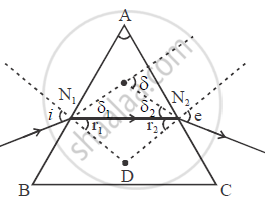
The variation in the angle of deviation with the angle of incidence at a prism surface
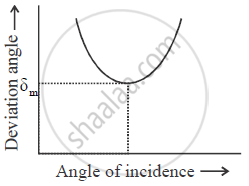
Graph between i and δm
RELATED QUESTIONS
Explain how the formation of a rainbow occurs.
If the speed of light in vacuum is 3 × 10⁸ ms−1, find the speed of light in a medium of absolute refractive index 1.5.
How can you bend light away from the normal?
In the adjacent diagram, AO is a ray of light incident on a rectangular glass slab.

- Complete the path of the ray till it emerges out of the slab.
- In the diagram, mark the angle of incidence (i) and the angle of refraction (r) at the first interface. How is the refractive index of glass related to the angles i and r?
- Mark angles of emergence by the letter e. How are the angles i and e related?
- Which two rays are parallel to each other? Name them.
- Indicate in the diagram the lateral displacement between the emergent ray and the incident ray. State one factor that affects the lateral displacement.
In fig 4.18, name the ray which represents the correct path of light while emerging out through a glass block.
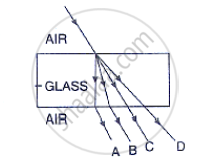
Fig shows a lens as a combination of a glass block and two prisms.
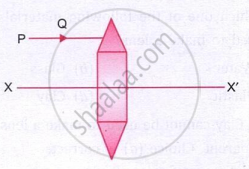
- Name the lens formed by the combination.
- What is the line XX' called?
- Complete the path of the incident ray PQ after passing through the lens.
- The final emergent ray either meets XX' at a point or appears to come from a point on XX'. Label it as F, What is this point called?
During sunset and sunrise, the sun is seen when it is slightly below the horizon. Give reason.
What is the refractive index of water
Why does the sun appear bigger during sunset or sunrise?
A coin placed at the bottom of a beaker appears to be raised by 4.0 cm. If the refractive index of water is 4/3, find the depth of the water in the beaker.
