Advertisements
Advertisements
Question
Explain briefly what causes the twinkling of stars at night.
Advertisements
Solution
Stars are very far from us. The light ray coming from a star undergoes successive refractions on entering the earth’s atmosphere and bends towards the normal. Hence, an apparent image of the star is seen. Simultaneously due to the movement of air, the refractive index of layers of atmosphere keeps on changing, i.e., the apparent position of star keeps changing. Thus, the star appears to twinkle.
RELATED QUESTIONS
Select from the following the best experimental setup for tracing the path of a ray of light passing through a rectangular glass slab.
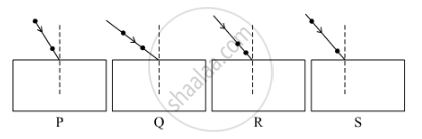
(a) P
(b) Q
(c) R
(d) S
Name one factor that affects the lateral displacement of light as it passes through a rectangular glass slab.
A student traces the path of a ray of white light through a rectangular glass slab and marks, the angles of incidence (∠i) , refraction (∠r) and emergence (∠e) as shown. Which angle or angles has he not marked correctly?

(A) ∠i only
(B) ∠i and ∠r
(C) ∠i and ∠e
(D) ∠r and ∠e
Which colour of light travels fastest in any medium except air?
How is the refractive index of a medium related to its real depth and apparent depth?
Complete the ray diagram showing its emergence into the air after passing through the prism.

How will you verify the laws of refraction or how the refractive index of glass is determined in the laboratory?
Explain with the help of a diagram of how fish is able to see the objects above it.
A glass block is having refractive index 3/2, the light ray is incident at an angle 45°. Find the sine of the angle of, refraction inside the glass block.
