Advertisements
Advertisements
Question
Observe the following figure and answer the questions given under it:

1) How many times does refraction take place in the above figure?
2) What happens to the ray of light when it passes from air to glass?
3) What happens to the ray of light when it passes from glass to air?
4) What are the rays AB and CD in the figure called?
5) Define refraction.
Advertisements
Solution
An expression for heat produced in a conductor by using Joule's experiment:
1) Refraction occurs twice, once at Point N and the second time at Point M.
2) Air is rarer than glass. So, when light passes from the rarer medium to the denser medium, it bends towards the normal.
3) When light passes from the denser (glass) medium to the rarer (air) medium, it bends away from the normal.
4) Ray AB is called the incident ray, and ray CD is called the emergent ray.
5) Refraction of light is the phenomenon of change in the direction of propagation of light when it passes obliquely from one transparent medium to another.
APPEARS IN
RELATED QUESTIONS
How is the reflection of light ray from a plane mirror different from the refraction of light ray as it enters a block of glass?
A ray of light is passing from a transparent medium 1 to another transparent medium 2 (i) Speed up (ii) slows down. In each case, state whether the refractive index of medium 2 is equal to, less than or greater than the refractive index of medium 1.
Complete Fig. 4.32 to show the path of the ray of single colour as it enters the prism and emerges out of it. Mark the angles wherever necessary.
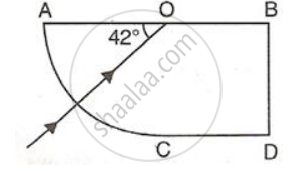
A ray of light enters a glass slab ABDC as shown in figure and strikes at the centre O of the circular part AC of the slab. The critical angle of glass is 42°. Complete the path of the ray till it emerges out from the slab. Mark the angles in the diagram wherever necessary.
While tracing the path of a ray of light passing through a rectangular glass slab a student tabulated his observations as given below:
|
S.NO. |
∠i |
∠r |
∠e |
|
I |
60° |
40° |
61° |
|
II |
50° |
36° |
51° |
|
III |
40° |
28° |
39° |
|
IV |
30° |
20° |
31° |
The correct observations is:
(A) I
(B) II
(C) III
(D) IV
Four students showed the following traces of the path of a ray of light passing through a rectangular glass slab.

The trace most likely to be correct is that of student
(A) I
(B) II
(C) III
(D) IV
A ray of light strikes the surface at a rectangular glass slab such that the angle of incidence is 45o.
In each case, draw diagram to show the path taken by the ray as it passes through the glass slab and emerges from it.
Choose the correct alternative and rewrite the following:
A glass slab is placed in the path of convergent light. The point of convergence of light
Name the phenomenon responsible in the following case:
Apparent bending of a stick in water
Why does a fisherman aim at the tail of fish during spearfishing?
State the factors on which the angle of deviation depends.
What do you understand by the deviation produced by a prism?
You are provided with a printed piece of paper. Using this paper how will you differentiate between a convex lens and a concave lens?
A ray of light moves from a rare medium to a dense medium as shown in the diagram below. Write down the number of the ray which represents the partially reflected ray.

Complete the ray diagram showing its emergence into the air after passing through the prism.

The diagram shows the path of a ray of light through a rectangular glass block placed in a liquid of uniform density.

What is the angular, deviation of the emergent ray from the glass block with respect to the incident ray?
The diagram shows the path of a ray of light through a rectangular glass block placed in a liquid of uniform density.
Show with the help of a ray diagram the path of the ray when incident ray normally falls on the first surface of the glass block and passes through the block and the liquid.
The refractive index of glass with respect to air is 3/2. What is the refractive index of air with respect to glass?
