Advertisements
Advertisements
Question
What do you understand by the deviation produced by a prism?
Advertisements
Solution
When a ray of light passes through a prism, it bends towards the base of the prism. Thus, the path of the emergent ray differs from the path of the incident ray. This is called the deviation produced by a prism.
RELATED QUESTIONS
A student traces the path of a ray of light passing through a rectangular glass slab and marks the angle of incidence i, angle of refraction r and angle of emergence e, as shown.
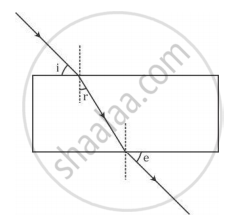
The correctly marked angle(s) is/are
(A) ∠ i only
(B) ∠ e only
(C) ∠ r only
(D) ∠ i and ∠ e
Which colour of light travels fastest in any medium except air?
Name a prism required for obtaining a spectrum of Ultraviolet light.
A ray of light strikes the surface of a rectangular glass block such that the angle of incidence in
air is 0°.
In each case, draw diagram to show the path taken by the ray as it passes through the glass block and emerges from it.
What do you understand by the statement the refractive index of glass is 1.5 for white light?
What is the correct reason for blinking / flickering of stars? Explain it.
a) The blasts in the stars.
b) Absorption of star light by the atmosphere.
c) Motion of the stars.
d) Changing refractive index of gases in the atmosphere.
Rewrite the following statement by selecting the correct option:
If a ray of light strikes a glass slab at an angle of 600 with the surface of the slab, the angle of incidence must be __________________.
How does the angle of deviation produced by a prism depend on the angle of incidence of light at the prism surface? Draw a graph to illustrate your answer.
The refractive index of glass with respect to air is 1.5. What is the value of the refractive index of air with respect to glass?
