Advertisements
Advertisements
Question
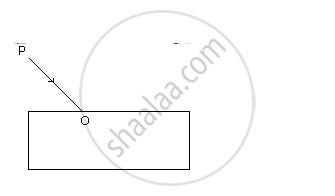
In the fig., PO is a ray of light incident on a rectangular glass block.
(a) Complete the path of the ray through the block.
(b) In the diagram, mark the angle of incidence (i) and the angle of refraction (r) at the first interface. How is the refractive index of glass related to the angles I and r?
(c) Mark angle of emergence by the letter e. How are the angles i and e related?
(d) Which two rays are parallel to each other? Name them.
(e) Indicate in the diagram the lateral displacement between the emergent ray and the incident ray.
Advertisements
Solution
(a) Diagram showing complete path of light :
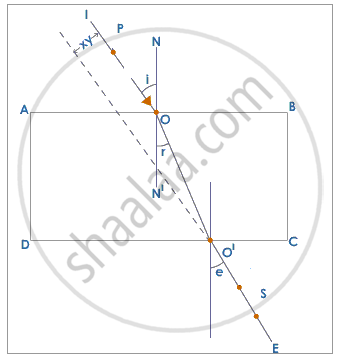
(b) Angle of incidence and angle of refraction marked in the above diagram.
R.I = `"sin i"/"sin r"`
(c) Angle of emergence is marked in the above diagram.
Angle of incidence = Angle of emergence
(d) Rays IO and O'E are parallel to each other. These are incident and emergent rays respectively.
(e) In the diagram above, the lateral displacement is indicated by XY.
APPEARS IN
RELATED QUESTIONS
A ray of light is passing from a transparent medium 1 to another transparent medium 2 (i) Speed up (ii) slows down. In each case, state whether the refractive index of medium 2 is equal to, less than or greater than the refractive index of medium 1.
How is the angle of emergence related to the angle of incidence when prism is in the position of minimum deviation? Illustrate your answer with help of a labelled diagram using an equilateral prism?
A postage stamp kept below a rectangular glass block of refractive index 1.5 when viewed from vertically above it, appears to be raised by 7.0 mm. Calculate the thickness of the glass slab.
A total reflecting right angled isosceles prism can be used to deviate a ray of light through:
(a) 30° (b) 60° (c) 75° (d) 90°.
Fig shows a lens as a combination of a glass block and two prisms.
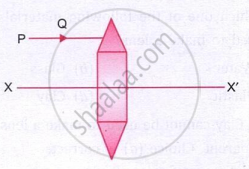
- Name the lens formed by the combination.
- What is the line XX' called?
- Complete the path of the incident ray PQ after passing through the lens.
- The final emergent ray either meets XX' at a point or appears to come from a point on XX'. Label it as F, What is this point called?
Make the correct for each of the following :
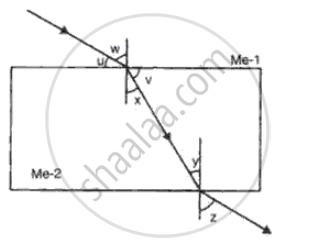
With reference to the fig, the refractive index of the glass block is
Using the curve, how do you infer that for given prism, the angle of minimum deviation δmin is unique for the given light?
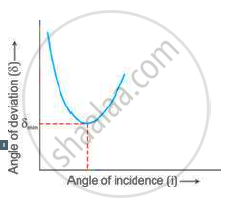
How does the deviation produced by a prism depend on the wavelength of incident light?
Can the absolute refractive index of a medium be less than one?
Draw the ray diagram of a glass slab having medium A and B for the velocity of light ray VA and VB respectively and define Snell's law.
- If VB = 1.5 VA, then which medium is denser?
- What is the refractive index of A with respect to B?
- What is the refractive index of B with respect to A?
