Advertisements
Advertisements
प्रश्न
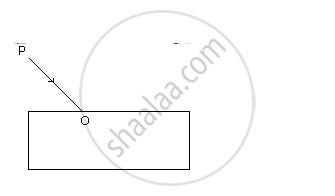
In the fig., PO is a ray of light incident on a rectangular glass block.
(a) Complete the path of the ray through the block.
(b) In the diagram, mark the angle of incidence (i) and the angle of refraction (r) at the first interface. How is the refractive index of glass related to the angles I and r?
(c) Mark angle of emergence by the letter e. How are the angles i and e related?
(d) Which two rays are parallel to each other? Name them.
(e) Indicate in the diagram the lateral displacement between the emergent ray and the incident ray.
Advertisements
उत्तर
(a) Diagram showing complete path of light :
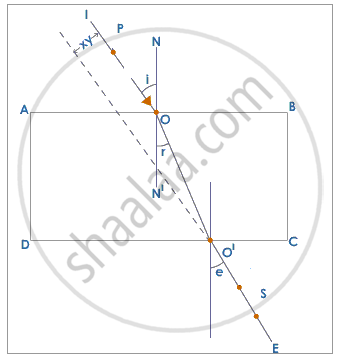
(b) Angle of incidence and angle of refraction marked in the above diagram.
R.I = `"sin i"/"sin r"`
(c) Angle of emergence is marked in the above diagram.
Angle of incidence = Angle of emergence
(d) Rays IO and O'E are parallel to each other. These are incident and emergent rays respectively.
(e) In the diagram above, the lateral displacement is indicated by XY.
APPEARS IN
संबंधित प्रश्न
A student traces the path of a ray of light through a rectangular glass slab for the different values of angle of incidence. He observes all possible precautions at each step of the experiment. At the end of the experiment, on analyzing the measurements, which of the following conclusions is he likely to draw?
(A) ∠i = ∠e < ∠r
(B) ∠i < ∠e < ∠r
(C) ∠i > ∠e > ∠r
(D) ∠i = ∠e > ∠r
Draw a ray diagram to show the refraction of a monochromatic ray through a prism when it suffers minimum deviation.
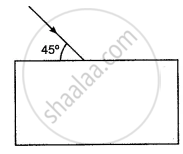
Draw the diagram given below and clearly show the path taken by the emergent ray.
The highest refractive index is of ______.
A ray of light of wavelength 6600 Å suffer refraction from air to glass. Taking \[\ce{_a\mu_g = \frac{3}{2}}\], find the wavelength of light in glass.
How does the angle of minimum deviation produces by a prism change with increase in :
the wavelength of incident light
How is the angle of emergence related to the angle of incidence when prism is in the position of minimum deviation? Illustrate your answer with help of a labelled diagram using an equilateral prism?
A student has traced the path of a ray of light through a glass slab as follows. If you are asked to label 1, 2, 3 and 4, the correct sequencing of labeling ∠i, ∠e, ∠r and lateral displacement respectively is
(a) 2, 1, 3, 4
(b) 1, 2, 3, 4
(c) 1, 3, 2, 4
(d) 1, 3, 4, 2
The critical angle for glass-air interface is :
A ray of monochromatic light is incident from air into a glass slab. Draw a labelled ray diagram indicating the change in its path till it emerges out of the slab. In the diagram, mark the angle of incidence (i) and the angle of refraction (r) at the first interface. How is the refractive index of glass related to the angles i and r?
