Advertisements
Advertisements
प्रश्न
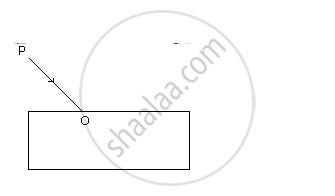
In the fig., PO is a ray of light incident on a rectangular glass block.
(a) Complete the path of the ray through the block.
(b) In the diagram, mark the angle of incidence (i) and the angle of refraction (r) at the first interface. How is the refractive index of glass related to the angles I and r?
(c) Mark angle of emergence by the letter e. How are the angles i and e related?
(d) Which two rays are parallel to each other? Name them.
(e) Indicate in the diagram the lateral displacement between the emergent ray and the incident ray.
Advertisements
उत्तर
(a) Diagram showing complete path of light :
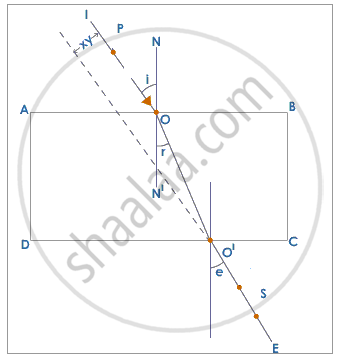
(b) Angle of incidence and angle of refraction marked in the above diagram.
R.I = `"sin i"/"sin r"`
(c) Angle of emergence is marked in the above diagram.
Angle of incidence = Angle of emergence
(d) Rays IO and O'E are parallel to each other. These are incident and emergent rays respectively.
(e) In the diagram above, the lateral displacement is indicated by XY.
APPEARS IN
संबंधित प्रश्न
Study the following four experimental set-ups I, II, III and IV for the experiment, "To trace the path of a ray of light through a rectangular glass slab."

Which of the marked set-ups is likely to give best results (P1 and P2 are the positions of pins fixed on the incident ray)?
(A) I
(B) II
(C) III
(D) IV
Draw a ray diagram to show the refraction of a monochromatic ray through a prism when it suffers minimum deviation.
Observe the following figure and answer the questions given under it:

1) How many times does refraction take place in the above figure?
2) What happens to the ray of light when it passes from air to glass?
3) What happens to the ray of light when it passes from glass to air?
4) What are the rays AB and CD in the figure called?
5) Define refraction.
How can you bend light away from the normal?
Fill in the blanks to complete the following sentence
When light travels from a denser to a rarer medium, its speed ……………….
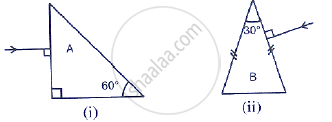
Fig 4.31 below shows a light ray of single colour incident normally on two prisms A and B. In each case draw the path of the ray of light as it enters and emerges out of the prism. Mark the angle wherever necessary.
Light of a single colour is passed through a liquid having a piece of glass suspended in it. On changing the temperature of liquid, at a particular temperature, the glass piece is not seen.
Why is the light of a single colour used ?
Name one main factor on which the direction of bending of a ray of light depends.
Write the approximate values of speed of light in (i) air and (ii) glass. Use these values to calculate the refractive index of glass with respect to air.
