Advertisements
Advertisements
प्रश्न
Light of a single colour is passed through a liquid having a piece of glass suspended in it. On changing the temperature of liquid, at a particular temperature, the glass piece is not seen.
Why is the light of a single colour used ?
Advertisements
उत्तर
Light of a single colour is used because the refractive index of a medium (glass or liquid) is different for the light of different colours.
APPEARS IN
संबंधित प्रश्न
A student traces the path of a ray of light passing through a rectangular glass slab and marks the angle of incidence i, angle of refraction r and angle of emergence e, as shown.
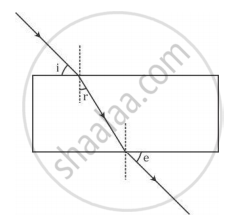
The correctly marked angle(s) is/are
(A) ∠ i only
(B) ∠ e only
(C) ∠ r only
(D) ∠ i and ∠ e
A student very cautiously traces the path of a ray through a glass slab for different values of the angle of incidence (∠i). He then measures the corresponding values of the angle of refraction (∠r) and the angle of emergence (∠e) for every value of the angle of incidence. On analysing these measurements of angles, his conclusion would be
(A) ∠i > ∠r > ∠e
(B) ∠i = ∠e > ∠r
(C) ∠i < ∠r < ∠e
(D) ∠i = ∠e < ∠r
Observe the following figure and answer the questions given under it:

1) How many times does refraction take place in the above figure?
2) What happens to the ray of light when it passes from air to glass?
3) What happens to the ray of light when it passes from glass to air?
4) What are the rays AB and CD in the figure called?
5) Define refraction.
A ray of light strikes the surface of a rectangular glass block such that the angle of incidence in
air is 0°.
In each case, draw diagram to show the path taken by the ray as it passes through the glass block and emerges from it.
A student has traced the path of a ray of light through a glass slab as follows. If you are asked to label 1, 2, 3 and 4, the correct sequencing of labeling ∠i, ∠e, ∠r and lateral displacement respectively is
(a) 2, 1, 3, 4
(b) 1, 2, 3, 4
(c) 1, 3, 2, 4
(d) 1, 3, 4, 2
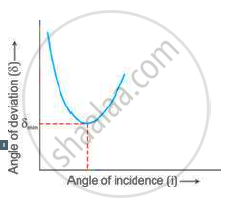
Using the curve, how do you infer that for given prism, the angle of minimum deviation δmin is unique for the given light?
What should be the ratio of the speed of light through the liquid to the speed through the glass so that there is no refraction of light at the boundaries of the glass block when the system is illuminated by the light of one colour?
Why does the sun appear bigger during sunset or sunrise?
The refractive index of air with respect to glass is defined: as gµa = sin i/sin r
Write down a similar expression for aµg in terms of angle i and r.
Explain with the help of a diagram of how fish is able to see the objects above it.
