Advertisements
Advertisements
प्रश्न
Explain with the help of a diagram of how fish is able to see the objects above it.
Advertisements
उत्तर
A fish can see everything above it in clear water irrespective of its position in different depths. The critical angle for water is 48.5°. The angle of the cone of vision for the fish is twice this angle.

Hence it is 97°. All the objects outside water but in this cone of vision Will be seen by the fish. Outside this range, the fish will see all the objects in the surrounding area (see figure). Those objects which are at the bottom will be seen by the fish due to total internal reflection taking place at the water-air interface.
संबंधित प्रश्न
Why do we get a spectrum of seven colors when white light is dispersed by a prism?
Light passes through a rectangular glass slab and through a triangular glass prism. In what way does the direction of the two emergent beams differ and why?
Fig shows a lens as a combination of a glass block and two prisms.
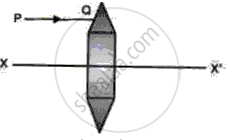
(i) Name the lens formed by the combination.
(ii) what is the XX' called?
(iii) Complete the ray diagram and show the path of the incident ray PQ after passing through the lens.
(iv) The final emergent ray will either meet XX' at a point or appear to come from a point on XX'. what is the point called?
Draw a ray diagram showing the lateral displacement of a ray of light when it passes through a parallel sided glass slab.
Name the phenomenon responsible in the following case:
Apparent bending of a stick in water
Why do the faces of persons sitting around campfire appear to shimmer?
A ray of light PQ is incident normally on the hypotenuse of a right-angled prism ABC as shown in the diagram given below:

(i) Copy the diagram and complete the path of the ray PQ till it emerges from the prism.
(ii) What is the value of the angle of deviation of the ray?
(iii) Name an instrument where this action of the prism is used.
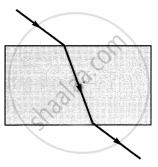
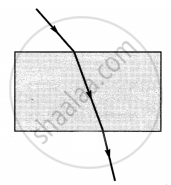
The path of a ray of light coming from air passing through a rectangular glass slab traced by four students are shown as A, B, C and D in the figure. Which one of them is correct?
 |
 |
 |
 |
| A | B | C | D |
