Advertisements
Advertisements
Question
Explain with the help of a diagram of how fish is able to see the objects above it.
Advertisements
Solution
A fish can see everything above it in clear water irrespective of its position in different depths. The critical angle for water is 48.5°. The angle of the cone of vision for the fish is twice this angle.

Hence it is 97°. All the objects outside water but in this cone of vision Will be seen by the fish. Outside this range, the fish will see all the objects in the surrounding area (see figure). Those objects which are at the bottom will be seen by the fish due to total internal reflection taking place at the water-air interface.
RELATED QUESTIONS
What is a spectrum?
A student traces the path of a ray of light passing through a rectangular glass slab and marks the angle of incidence i, angle of refraction r and angle of emergence e, as shown.
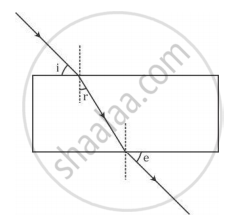
The correctly marked angle(s) is/are
(A) ∠ i only
(B) ∠ e only
(C) ∠ r only
(D) ∠ i and ∠ e
The diagram alongside shows the refraction of a ray of light from air to a liquid.
- Write the values of (i) angle of incidence, (ii) angle of refraction.
- Use Snell’s law to find the refractive index of liquid with respect to air.

In fig 4.18, name the ray which represents the correct path of light while emerging out through a glass block.
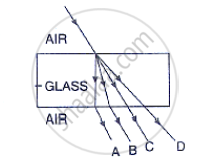
What is the correct reason for blinking / flickering of stars? Explain it.
a) The blasts in the stars.
b) Absorption of star light by the atmosphere.
c) Motion of the stars.
d) Changing refractive index of gases in the atmosphere.
The critical angle for glass-air interface is :
What is the refractive index of water
Define the term refractive index of a medium in terms of velocity of light.
How will you verify the laws of refraction or how the refractive index of glass is determined in the laboratory?
Draw a diagram of a prism and label:
(i) the base,
(ii) the refracting surfaces,
(iii) the refracting edge,
(iv) the refracting angle in it.
