Advertisements
Advertisements
Question
What is the correct reason for blinking / flickering of stars? Explain it.
a) The blasts in the stars.
b) Absorption of star light by the atmosphere.
c) Motion of the stars.
d) Changing refractive index of gases in the atmosphere.
Advertisements
Solution
d) Changing refractive index of gases in the atmosphere.
Atmosphere is unstable due to changing density and temperature of air, hence refractive index of air keeps changing continuously. The position and brightness of the star keep changing continuously and the star appears to be twinkling.
APPEARS IN
RELATED QUESTIONS
What is a spectrum?
A student very cautiously traces the path of a ray through a glass slab for different values of the angle of incidence (∠i). He then measures the corresponding values of the angle of refraction (∠r) and the angle of emergence (∠e) for every value of the angle of incidence. On analysing these measurements of angles, his conclusion would be
(A) ∠i > ∠r > ∠e
(B) ∠i = ∠e > ∠r
(C) ∠i < ∠r < ∠e
(D) ∠i = ∠e < ∠r
Observe the following figure and answer the questions given under it:

1) How many times does refraction take place in the above figure?
2) What happens to the ray of light when it passes from air to glass?
3) What happens to the ray of light when it passes from glass to air?
4) What are the rays AB and CD in the figure called?
5) Define refraction.
What do you understand by the statement the refractive index of glass is 1.5 for white light?
An object is viewed through a glass prism with its vertex pointing upwards. It appears to be displaced upward. Explain the reason.
The refractive index of glass is 1.5. From a point P inside a glass block, draw rays PA, PB and PC incident on the glass air surface at an angle of incidence 30°, 42° and 60° respectively.
- In the diagram show the approximate direction of these rays as they emerge out of the block.
- What is the angle of refraction for the ray PB?
`("Take" sin 42° =2/3)`
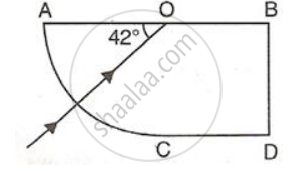
A ray of light enters a glass slab ABDC as shown in figure and strikes at the centre O of the circular part AC of the slab. The critical angle of glass is 42°. Complete the path of the ray till it emerges out from the slab. Mark the angles in the diagram wherever necessary.
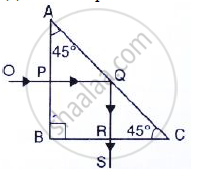
A ray of light OP passes through a right angles prism as shown in the adjacent diagram.
(a) State the angles of incidence at the faces AC and BC.
(b) Name the phenomenon which the ray suffers at the face AC.
Light of a single colour is passed through a liquid having a piece of glass suspended in it. On changing the temperature of liquid, at a particular temperature, the glass piece is not seen.
Why is the light of a single colour used ?
How does the deviation produced by a prism depend on the wavelength of incident light?
Which colour of light travels fastest in any medium except air?
During sunset and sunrise, the sun is seen when it is slightly below the horizon. Give reason.
A glass slab is placed over a page on which the word VIBGYOR is printed with each letter in its corresponding colour.
- Will the image of all the letters be in the same place?
- If not, the state which letter will be raised to the maximum. Give a reason for your answer.
State the relation between the refractive index μ and the velocity of light (vm) in that medium.
Can the absolute refractive index of a medium be less than one?
A ray of light moves from a rare medium to a dense medium as shown in the diagram below. Write down the number of the ray which represents the partially reflected ray.

In the diagram below, PQ is a ray of light incident on a rectangular glass block.

How are the angles ‘i’ and ‘e’ related to each other?
A ray of monochromatic light is incident from air into a glass slab. Draw a labelled ray diagram indicating the change in its path till it emerges out of the slab. In the diagram, mark the angle of incidence (i) and the angle of refraction (r) at the first interface. How is the refractive index of glass related to the angles i and r?
