Advertisements
Advertisements
Question
Light of a single colour is passed through a liquid having a piece of glass suspended in it. On changing the temperature of liquid, at a particular temperature the glass piece is not seen. When is the glass piece not seen?
Advertisements
Solution
The glass piece is not seen when the refractive index of liquid becomes equal to the refractive index of glass.
APPEARS IN
RELATED QUESTIONS
A student traces the path of a ray of light passing through a rectangular glass slab and marks the angle of incidence i, angle of refraction r and angle of emergence e, as shown.
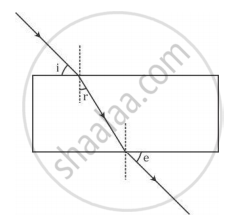
The correctly marked angle(s) is/are
(A) ∠ i only
(B) ∠ e only
(C) ∠ r only
(D) ∠ i and ∠ e
Study the following four experimental set-ups I, II, III and IV for the experiment, "To trace the path of a ray of light through a rectangular glass slab."

Which of the marked set-ups is likely to give best results (P1 and P2 are the positions of pins fixed on the incident ray)?
(A) I
(B) II
(C) III
(D) IV
Why do we get a spectrum of seven colors when white light is dispersed by a prism?
Write a relationship between the angle of incidence and angle of refractions for a given pair of media.
How is the reflection of light ray from a plane mirror different from the refraction of light ray as it enters a block of glass?
State the factors on which the angle of deviation depends.
Express the refractive index μ of a medium in terms of the velocity of light.
The figure shows two prisms A and B. A monochromatic ray of light PO is incident at the face of the prism A. Complete the diagram to show the path of the ray till it emerges out of the prism B.

In the diagram alongside a ray of light, PQ is incident normally on one face AB of an equilateral glass prism. What is the angle of incidence at the faces AB and AC?

The diagram shows the path of a ray of light through a rectangular glass block placed in a liquid of uniform density.

(a) Does the light speed up or slow down in the glass,
(b) Give the reason for your answer.
