Advertisements
Advertisements
Question
State the dependence of angle of deviation on the refractive index of the material of the prism.
Advertisements
Solution
For a given angle of incidence, the prism with a higher refractive index produces a greater deviation than the prism which has a lower refractive index. Thus, the angle of deviation increases with an increase in the refractive index of the medium.
APPEARS IN
RELATED QUESTIONS
Explain how spectrum is formed.
Study the following four experimental set-ups I, II, III and IV for the experiment, "To trace the path of a ray of light through a rectangular glass slab."

Which of the marked set-ups is likely to give best results (P1 and P2 are the positions of pins fixed on the incident ray)?
(A) I
(B) II
(C) III
(D) IV
A ray of light passes from water to air. How does the speed of light change?
Light of a single colour is passed through a liquid having a piece of glass suspended in it. On changing the temperature of liquid, at a particular temperature the glass piece is not seen. When is the glass piece not seen?
The refractive index of glass is 1.5. From a point P inside a glass block, draw rays PA, PB and PC incident on the glass air surface at an angle of incidence 30°, 42° and 60° respectively.
- In the diagram show the approximate direction of these rays as they emerge out of the block.
- What is the angle of refraction for the ray PB?
`("Take" sin 42° =2/3)`
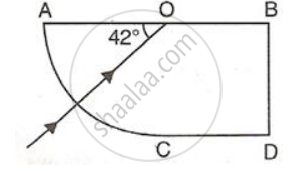
A ray of light enters a glass slab ABDC as shown in figure and strikes at the centre O of the circular part AC of the slab. The critical angle of glass is 42°. Complete the path of the ray till it emerges out from the slab. Mark the angles in the diagram wherever necessary.
In an experiment of finding the refractive index of glass, if blue light is replaced by the red light, how will the refractive index of glass change? Give reason in support of your answer.
Draw a ray diagram showing the lateral displacement of a ray of light when it passes through a parallel sided glass slab.
You are provided with a printed piece of paper. Using this paper how will you differentiate between a convex lens and a concave lens?
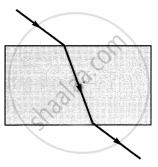
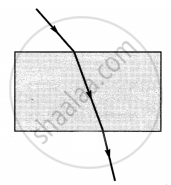
The path of a ray of light coming from air passing through a rectangular glass slab traced by four students are shown as A, B, C and D in the figure. Which one of them is correct?
 |
 |
 |
 |
| A | B | C | D |
