Advertisements
Advertisements
प्रश्न
Light of a single colour is passed through a liquid having a piece of glass suspended in it. On changing the temperature of liquid, at a particular temperature the glass piece is not seen. When is the glass piece not seen?
Advertisements
उत्तर
The glass piece is not seen when the refractive index of liquid becomes equal to the refractive index of glass.
APPEARS IN
संबंधित प्रश्न
When a ray of light travels from air to glass slab and strikes the surface of separation at 90°, then it …………….
(a) bends towards normal
(b) bends away from normal
(c) passes unbent
(d) passes in zigzag way
Explain how the formation of a rainbow occurs.
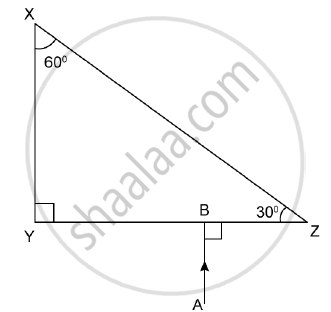
The following diagram shows a 60°, 30°, 90° glass prism of critical angle 42°, Copy the diagram and complete the path of incident ray AB emerging out of the prism marking the angle of incidence on each surface.
How is the reflection of light ray from a plane mirror different from the refraction of light ray as it enters a block of glass?
The refractive index of glass is 1.5. From a point P inside a glass block, draw rays PA, PB and PC incident on the glass air surface at an angle of incidence 30°, 42° and 60° respectively.
- In the diagram show the approximate direction of these rays as they emerge out of the block.
- What is the angle of refraction for the ray PB?
`("Take" sin 42° =2/3)`
-
- the angle of refraction and
- the angle of deviation for the ray?
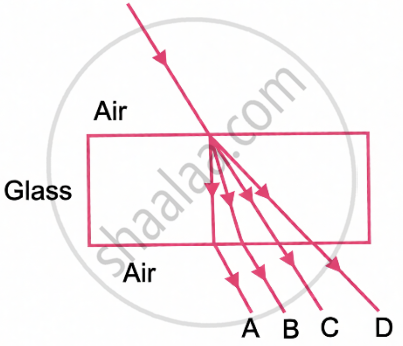
In the fig. name the ray which represents the correct path of light while passing through a glass block.
Can the absolute refractive index of a medium be less than one?
What is the total reflecting prism?
In what condition a prism is said to be in the position of minimum deviation? What is the direction of the refracted ray inside the prism in this condition?
