Advertisements
Advertisements
प्रश्न
The refractive index of glass is 1.5. From a point P inside a glass block, draw rays PA, PB and PC incident on the glass air surface at an angle of incidence 30°, 42° and 60° respectively.
- In the diagram show the approximate direction of these rays as they emerge out of the block.
- What is the angle of refraction for the ray PB?
`("Take" sin 42° =2/3)`
Advertisements
उत्तर
- A diagram with rays PA, PB and PC is shown below:

- Given, μ = 1.5
As we know,
`sin i_c = 1/mu`
substituting the values in the formula, we get,
`sin i_c = 1/1.5`
sin ic = 0.667
ic = 41.8
Hence, we can round off ic = 42°
Applying `sin r/sin i = ""_amu_g`
sin r = `""_amu_g xx sin i`
sin r = `""_amu_g xx sin 42°`
Given, sin 42° = `2/3`
and `""_amu_g = 3/2`
substituting the value in the formula, we get,
`sin r = 3/2 xx 2/3`
sin r = 1
As sin r = 1, the angle of refraction is 90°.
APPEARS IN
संबंधित प्रश्न
State the dependence of angle of deviation on the wavelength of light
The speed of light in glass is 2 × 10⁵ km/s. What is the refractive index of glass?
When light travels from a rarer to a denser medium, its speed ______.
With the help of diagram of the principal section of a prism, indicate its refracting surfaces, refracting edge and base.
Draw a diagram to show the splitting of white light into its constituent colours.
Light of a single colour is passed through a liquid having a piece of glass suspended in it. On changing the temperature of liquid, at a particular temperature, the glass piece is not seen.
Why is the light of a single colour used ?
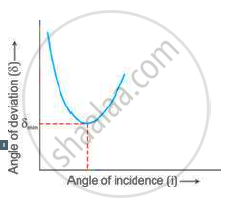
Using the curve, how do you infer that for given prism, the angle of minimum deviation δmin is unique for the given light?
What is the refractive index of water
In what condition a prism is said to be in the position of minimum deviation? What is the direction of the refracted ray inside the prism in this condition?
How does the angle of deviation produced by a prism depend on the angle of incidence of light at the prism surface? Draw a graph to illustrate your answer.
