Advertisements
Advertisements
प्रश्न
The refractive index of glass is 1.5. From a point P inside a glass block, draw rays PA, PB and PC incident on the glass air surface at an angle of incidence 30°, 42° and 60° respectively.
- In the diagram show the approximate direction of these rays as they emerge out of the block.
- What is the angle of refraction for the ray PB?
`("Take" sin 42° =2/3)`
Advertisements
उत्तर
- A diagram with rays PA, PB and PC is shown below:

- Given, μ = 1.5
As we know,
`sin i_c = 1/mu`
substituting the values in the formula, we get,
`sin i_c = 1/1.5`
sin ic = 0.667
ic = 41.8
Hence, we can round off ic = 42°
Applying `sin r/sin i = ""_amu_g`
sin r = `""_amu_g xx sin i`
sin r = `""_amu_g xx sin 42°`
Given, sin 42° = `2/3`
and `""_amu_g = 3/2`
substituting the value in the formula, we get,
`sin r = 3/2 xx 2/3`
sin r = 1
As sin r = 1, the angle of refraction is 90°.
APPEARS IN
संबंधित प्रश्न
Study the following four experimental set-ups I, II, III and IV for the experiment, "To trace the path of a ray of light through a rectangular glass slab."

Which of the marked set-ups is likely to give best results (P1 and P2 are the positions of pins fixed on the incident ray)?
(A) I
(B) II
(C) III
(D) IV
Draw the diagram of refraction of light in the glass slab
How can you bend light away from the normal?
Write the relation between the angle of incidence and the angle of refraction for a medium.
What do you understand by the statement the refractive index of glass is 1.5 for white light?
Fill in the blanks to complete the following sentence
The refractive index of glass with respect to air is 3/2. The refractive index of air with respect to glass will be ……………….
What is meant by the statement the critical angle for diamond is 24°?
The refractive index of air with respect to glass is expressed as `""_g μ_a=sin i /sin r`.
- Write down a similar expression for aμg in terms of the angles i and r.
- If angle r = 90°, what is the corresponding angle i called?
- What is the physical significance of the angle i in part (b)?
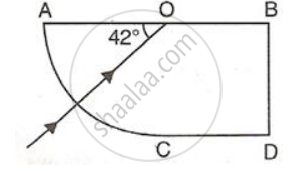
A ray of light enters a glass slab ABDC as shown in figure and strikes at the centre O of the circular part AC of the slab. The critical angle of glass is 42°. Complete the path of the ray till it emerges out from the slab. Mark the angles in the diagram wherever necessary.
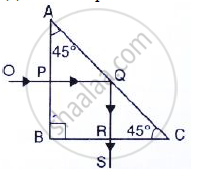
A ray of light OP passes through a right angles prism as shown in the adjacent diagram.
(a) State the angles of incidence at the faces AC and BC.
(b) Name the phenomenon which the ray suffers at the face AC.