Advertisements
Advertisements
प्रश्न
The diagram shows the path of a ray of light through a rectangular glass block placed in a liquid of uniform density.

What should be the rate of the speed of light through the liquid to the speed through the glass so that there is no refraction of light at the boundaries of the glass block when the system is illuminated by the light of one colour?
Advertisements
उत्तर
Since there is no refraction of light at the boundaries of the glass block, it is possible only when the speed of light through the liquid as well as through the block is the same. Hence the ratio between the speed of light through the liquid to the speed of light through glass must be 1 (one).
संबंधित प्रश्न
If the speed of light in vacuum is 3 × 10⁸ ms−1, find the speed of light in a medium of absolute refractive index 1.5.
Draw diagrams to show the refraction of light from
- air to glass, and
- glass to air. In each diagram, label the incident ray, refracted ray, the angle of incidence
- and the angle of refraction (r).
A ray of light strikes the surface of a rectangular glass block such that the angle of incidence in
air is 0°.
In each case, draw diagram to show the path taken by the ray as it passes through the glass block and emerges from it.
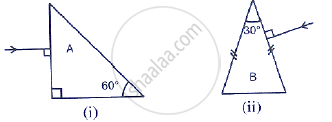
Fig 4.31 below shows a light ray of single colour incident normally on two prisms A and B. In each case draw the path of the ray of light as it enters and emerges out of the prism. Mark the angle wherever necessary.
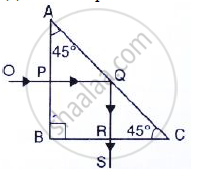
A ray of light OP passes through a right angles prism as shown in the adjacent diagram.
(a) State the angles of incidence at the faces AC and BC.
(b) Name the phenomenon which the ray suffers at the face AC.
A glass slab is placed over a page on which the word VIBGYOR is printed with each letter in its corresponding colour.
- Will the image of all the letters be in the same place?
- If not, the state which letter will be raised to the maximum. Give a reason for your answer.
State the factors on which the angle of deviation depends.
A ray of light moves from a rare medium to a dense medium as shown in the diagram below. Write down the number of the ray which represents the partially reflected ray.

The refractive index of glass with respect to air is 3/2. What is the refractive index of air with respect to glass?
