Advertisements
Advertisements
प्रश्न
Advertisements
उत्तर
APPEARS IN
संबंधित प्रश्न
State the dependence of angle of deviation on the refractive index of the material of the prism.
Name a prism required for obtaining a spectrum of Ultraviolet light.
How must light travel out of a substance if it is not going to be refracted?
Draw diagrams to show the refraction of light from
- air to glass, and
- glass to air. In each diagram, label the incident ray, refracted ray, the angle of incidence
- and the angle of refraction (r).
When a lighted candle is held in front of a thick plane glass mirror, several images can be seen, but the second image is the brightest, give reason.
The critical angle for glass-air is 45° for the light of yellow colour. State whether it will be less than, equal to, or more than 45° for (i) ref light, (ii) blue light?
Select from the following the best experimental set-up for tracing the path of a ray of light through a glass slab: (A) I
(A) I
(B) II
(C) III
(D) IV
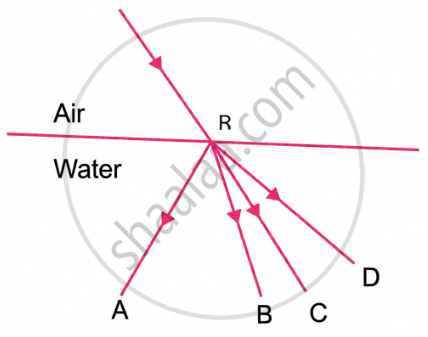
A ray of light passes from air to water. In fig., which of the ray A, B, C and D is the correct refracted ray?
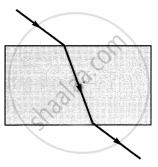
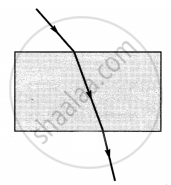
The path of a ray of light coming from air passing through a rectangular glass slab traced by four students are shown as A, B, C and D in the figure. Which one of them is correct?
 |
 |
 |
 |
| A | B | C | D |
