Advertisements
Advertisements
प्रश्न
To determine the refractive index of glass, place a glass block PQRS on a white paper and draw the boundary of the glass slab. Fix a pin O touching the glass slab on the side PS. Looking through the opposite face QR, fix two pins P1 and P2 along the same line as the image of the pin O. Remove the pins P1 and P2 and mark their positions. Join P1 and P2 and produce this line to cut the normal OA at I. Then I is the apparent position of O as seen through the glass slab (Fig.).
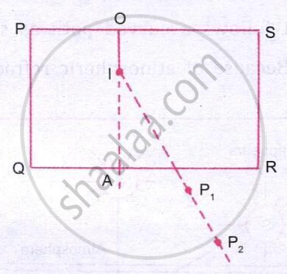
\(O A=\) Real depth (thickness) of the slab
\(I A=\) Apparent depth (thickness) of the slab
\[ \begin{aligned} \text { Refractive index }(\mu) & =\frac{\text { Real depth }}{\text { Apparent depth }} \\ & =\frac{O A}{I A} \end{aligned} \]
Advertisements
उत्तर
Aim: To determine the refractive index of a glass slab using real depth and apparent depth.
Principle: When the pin O is viewed through the glass slab, refraction makes its image appear raised. The original pin lies on the normal OA, while the apparent image lies at I nearer the top surface. Therefore, OA gives the real depth and IA gives the apparent depth.
Procedure:
- Place the glass slab PQRS on a white sheet and trace its outline.
- Fix a pin O touching the side PS of the slab.
- Looking through the opposite face QR, fix two pins P1 and P2 in line with the image of O.
- Remove P1 and P2, mark their positions, join them, and produce the line to cut the normal OA at I.
Observation:
- OA = real depth or actual thickness of the glass slab
- IA = apparent depth or apparent thickness of the glass slab
Formula: \[\mu = \frac{\text{Real depth}}{\text{Apparent depth}} = \frac{OA}{IA}\]
Conclusion: The refractive index of glass is obtained by measuring OA and IA and taking their ratio. Repeating the experiment for different positions of the pin improves accuracy.
