Advertisements
Advertisements
Question
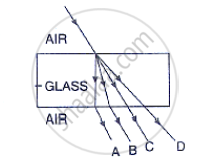
The diagram shows the path of a ray of light through a rectangular glass block placed in a liquid of uniform density.

What should be the rate of the speed of light through the liquid to the speed through the glass so that there is no refraction of light at the boundaries of the glass block when the system is illuminated by the light of one colour?
Advertisements
Solution
Since there is no refraction of light at the boundaries of the glass block, it is possible only when the speed of light through the liquid as well as through the block is the same. Hence the ratio between the speed of light through the liquid to the speed of light through glass must be 1 (one).
RELATED QUESTIONS
Explain how spectrum is formed.
Why is the ratio of the velocities of light of wavelengths 4000Å and 8000Å in vacuum 1: 1?
What do you understand by the statement the refractive index of glass is 1.5 for white light?
In fig 4.18, name the ray which represents the correct path of light while emerging out through a glass block.
Trace the path of a ray of light incident at an angle of 45° on a rectangular glass slab. Write the measure of the angle of refraction, the angle of emergence and the lateral displacement suffered by the ray as it passes through the slab.
After tracing the path of rays of light through a glass slab for three different angles of incidence, a student measured the corresponding values angle of refraction r and angle of emergence e and recorded them in the table given below:
|
S. No. |
∠i |
∠i |
∠e |
|
I |
30° |
20° |
31° |
|
II |
40° |
25° |
40° |
|
III |
50° |
31° |
49° |
The correct observations are:
(A) I and II
(B) II and III
(C) I and III
(D) I, II and III
While performing the experiment on tracing the path of a ray of light through a rectangular glass slab, in which of the following experimental set-ups is a student likely to get best results? P1 and P2 are the positions of pins fixed by him.
(A) I
(B) II
(C) III
(D) IV
Why upper surface of water contained in a beaker and above eye level appears silvery?
Draw a diagram of a prism and label:
(i) the base,
(ii) the refracting surfaces,
(iii) the refracting edge,
(iv) the refracting angle in it.
