Advertisements
Advertisements
Question
Advertisements
Solution
A prism itself produces no colour. This can be demonstrated by the following experiment.
Experiment: In figure below, white light from a slit s is made to pass through a prism P which forms the spectrum VR on a while screen AB. A narrow slit H is made on the screen AB parallel to the slit S to allow the light of a particular colour to pass through it. This light of a particular colour is made to fall on a seconf prism Q placed with its base in opposite directionj to that of the prism P. The light after passing through the second prism Q is recieved on another white screen M.
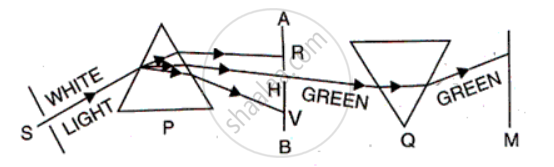
It is observed that the colour of light onbtained on the screen M is sames as that of the light incident on the second prism Q through the slit H. If green light is incident on the prism Q, the screen M has only green colour. This proves that the prism itself produces no coours.
APPEARS IN
RELATED QUESTIONS
For which colour of white light, is the refractive index of a transparent medium the most?
A ray of light is passing from a transparent medium 1 to another transparent medium 2 (i) Speed up (ii) slows down. In each case, state whether the refractive index of medium 2 is equal to, less than or greater than the refractive index of medium 1.
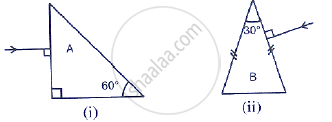
Fig 4.31 below shows a light ray of single colour incident normally on two prisms A and B. In each case draw the path of the ray of light as it enters and emerges out of the prism. Mark the angle wherever necessary.
What is meant by the refraction of light?
Which colour of light travels fastest in any medium except air?
The diagram shows the path of a ray of light through a rectangular glass block placed in a liquid of uniform density.

What should be the rate of the speed of light through the liquid to the speed through the glass so that there is no refraction of light at the boundaries of the glass block when the system is illuminated by the light of one colour?
The speed of light in air is 3 × 10⁸ ms-1. Calculate the speed of light in water. The refractive index of water is 4/3.
A ray of light is incident at an angle of 45° on one face of a rectangular glass slab of thickness 10 cm and refractive index 3/2. Calculate the lateral shift produced ______.
