Advertisements
Advertisements
Question
Rewrite the following statement by selecting the correct option:
If a ray of light strikes a glass slab at an angle of 600 with the surface of the slab, the angle of incidence must be __________________.
Options
60°
30°
40°
120°
Advertisements
Solution
If a ray of light strikes a glass slab at an angle of 600 with the surface of the slab, the angle of incidence must be 30°.
APPEARS IN
RELATED QUESTIONS
Name one factor that affects the lateral displacement of light as it passes through a rectangular glass slab.
Which colour of light travels fastest in any medium except air?
In the adjacent diagram, AO is a ray of light incident on a rectangular glass slab.

- Complete the path of the ray till it emerges out of the slab.
- In the diagram, mark the angle of incidence (i) and the angle of refraction (r) at the first interface. How is the refractive index of glass related to the angles i and r?
- Mark angles of emergence by the letter e. How are the angles i and e related?
- Which two rays are parallel to each other? Name them.
- Indicate in the diagram the lateral displacement between the emergent ray and the incident ray. State one factor that affects the lateral displacement.
A light ray in passing from water to a medium
(a) speeds up
(b) slows down. In each case, give one example of the medium.
What do you understand by the statement the refractive index of glass is 1.5 for white light?
In fig 4.18, name the ray which represents the correct path of light while emerging out through a glass block.
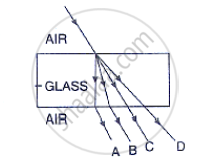
Name the colour of white light which is deviated the most on passing through a prism.
The refractive index of glass is 1.5. From a point P inside a glass block, draw rays PA, PB and PC incident on the glass air surface at an angle of incidence 30°, 42° and 60° respectively.
- In the diagram show the approximate direction of these rays as they emerge out of the block.
- What is the angle of refraction for the ray PB?
`("Take" sin 42° =2/3)`
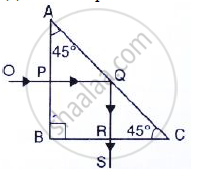
A ray of light OP passes through a right angles prism as shown in the adjacent diagram.
(a) State the angles of incidence at the faces AC and BC.
(b) Name the phenomenon which the ray suffers at the face AC.
After tracing the path of rays of light through a glass slab for three different angles of incidence, a student measured the corresponding values angle of refraction r and angle of emergence e and recorded them in the table given below:
|
S. No. |
∠i |
∠i |
∠e |
|
I |
30° |
20° |
31° |
|
II |
40° |
25° |
40° |
|
III |
50° |
31° |
49° |
The correct observations are:
(A) I and II
(B) II and III
(C) I and III
(D) I, II and III
Draw a ray diagram showing the lateral displacement of a ray of light when it passes through a parallel sided glass slab.
A ray of light strikes the surface at a rectangular glass slab such that the angle of incidence is 45o.
In each case, draw diagram to show the path taken by the ray as it passes through the glass slab and emerges from it.
Why upper surface of water contained in a beaker and above eye level appears silvery?
A fish swimming in a pond seems nearer than it really is. Explain.
How does the angle of deviation produced by a prism depend on the angle of incidence of light at the prism surface? Draw a graph to illustrate your answer.
A coin placed at the bottom of a beaker appears to be raised by 4.0 cm. If the refractive index of water is 4/3, find the depth of the water in the beaker.
A ray of light strikes the surface of a rectangular glass slab such that the angle of incidence in air is
- 0°,
- 45°.
In each case, draw a diagram to show the path taken by the ray as it passes through the glass slab and emerges from it.
