Advertisements
Advertisements
Question
Advertisements
Solution
According to the principle of reversibility, the path of a light ray is reversible.
For e.g. if light travels from air to water along a certain path, then if the path is reversed while travelling from water to air, it will follow exactly the same path.
APPEARS IN
RELATED QUESTIONS
On the basis of the experiment, "To trace the path of a ray of light through a rectangular glass slab", students of a class arrived at which one of the following conclusions?
(A) Angle of incidence is greater than the angle of emergence.
(B) Angle of emergence is smaller than the angle of refraction.
(C) Emergent ray is parallel to the refracted ray.
(D) Incident ray and emergent ray are parallel to each other.
Draw the diagram given below and clearly show the path taken by the emergent ray.
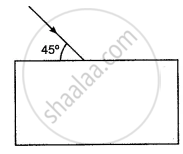
Name a prism required for obtaining a spectrum of Ultraviolet light.
Draw the diagram of refraction of light in the glass slab
Fig 4.31 below shows a light ray of single colour incident normally on two prisms A and B. In each case draw the path of the ray of light as it enters and emerges out of the prism. Mark the angle wherever necessary.
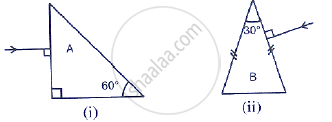
Why upper surface of water contained in a beaker and above eye level appears silvery?
A fish swimming in a pond seems nearer than it really is. Explain.
A ray of monochromatic light is incident from air into a glass slab. Draw a labelled ray diagram indicating the change in its path till it emerges out of the slab. In the diagram, mark the angle of incidence (i) and the angle of refraction (r) at the first interface. How is the refractive index of glass related to the angles i and r?
Explain with the help of a diagram of how fish is able to see the objects above it.
