Advertisements
Advertisements
Question
Explain how spectrum is formed.
Advertisements
Solution
When white light passes through a glass prism, it spreads out into a band of different colours called the spectrum of light.

- When white light is dispersed into seven colours by a glass prism, different colours bend through different angles with respect to the incident ray.
- The sequence of colours given by the prism is Violet, Indigo, Blue, Green, Yellow, Orange and Red.
- Of the seven colours, red light bends the least, while violet light bends the most. So, the rays of each colour emerge along different paths and appear distinct. Hence, we get a spectrum of seven different colours.
APPEARS IN
RELATED QUESTIONS
When light travels from a rarer to a denser medium, its speed ______.
Fill in the blanks to complete the following sentence
When light travels from a denser to a rarer medium, its speed ……………….
An object is viewed through a glass prism with its vertex pointing upwards. It appears to be displaced upward. Explain the reason.
Which of the following is the best experimental set-up out of the four shown for tracing the path of a ray of light passing through a rectangular glass slab ?
After tracing the path of rays of light through a glass slab for three different angles of incidence, a student measured the corresponding values angle of refraction r and angle of emergence e and recorded them in the table given below:
|
S. No. |
∠i |
∠i |
∠e |
|
I |
30° |
20° |
31° |
|
II |
40° |
25° |
40° |
|
III |
50° |
31° |
49° |
The correct observations are:
(A) I and II
(B) II and III
(C) I and III
(D) I, II and III
Observe the figure and write accurate conclusion regarding refraction of light.
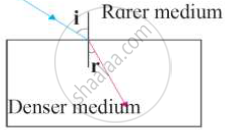
Fill in the blank to complete the following sentence:
When light travels from a rarer to a denser medium, it bends ...........
Draw an í- `delta` graph for a mono chromatic raY through a glass prism of a plane and mark
(i) `delta` m, the angle of mínimum devíation
(íí) Any two values of i for which value of `delta` ís same.
Using the curve, how do you infer that for given prism, the angle of minimum deviation δmin is unique for the given light?
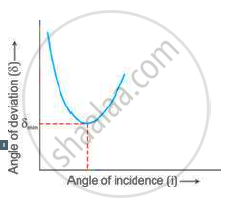
What is meant by the refraction of light?
Why upper surface of water contained in a beaker and above eye level appears silvery?
A ray of light passes from water to air. How does the speed of light change?
State the factors on which the angle of deviation depends.
After a robbery, if a window has been broken, there will be tiny particles of glass. Some of these will be found at the scene of the crime and some may be caught in the thief’s clothing. If the police can prove that these particles are identical, they have a strong case.
A method of doing this is to suspend the particles of glass in a special liquid. Light of a single colour is thrown through the liquid and the particles viewed through a microscope. The temperature of the liquid is then slowly altered. This alters the speed of light through the liquid (i.e., it alters the refractive index). At one particular temperature, the particles of glass disappear. It this happens at the same temperature for both sets of glass particles, they probably came from the same broken pane of glass.
Complete and copy the diagram to show how light bends when it travels from the liquid to the glass and back to the liquid, If the light slows down in the glass.
Observe the figure and name the ray AB, ray CD, ray GH.

The diagram below shows two parallel rays A (Orange) & B (Blue) incident from air, on air-glass boundary.

- Copy and complete the path of the rays A and B.
- How do the speeds of these rays differ in glass?
- Are the two refracted rays in glass parallel? Give a reason.
