Advertisements
Advertisements
Question
Draw diagrams to show the refraction of light from glass to air. In diagram, label the incident ray, refracted ray, the angle of incidence (i) and the angle of refraction (r).
Advertisements
Solution
Diagram showing the refraction of light from Glass to Air

RELATED QUESTIONS
Choose the correct alternative and rewrite the following sentence.
A ray of light strikes the glass slab at an angle of 50°. What is the angle of incidence?
Observe the following figure and answer the questions given under it:

1) How many times does refraction take place in the above figure?
2) What happens to the ray of light when it passes from air to glass?
3) What happens to the ray of light when it passes from glass to air?
4) What are the rays AB and CD in the figure called?
5) Define refraction.
How must light travel out of a substance if it is not going to be refracted?
With the help of diagram of the principal section of a prism, indicate its refracting surfaces, refracting edge and base.
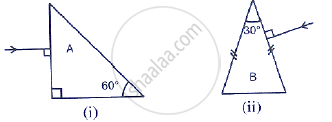
Fig 4.31 below shows a light ray of single colour incident normally on two prisms A and B. In each case draw the path of the ray of light as it enters and emerges out of the prism. Mark the angle wherever necessary.
The refractive index of air with respect to glass is expressed as `""_g μ_a=sin i /sin r`.
- Write down a similar expression for aμg in terms of the angles i and r.
- If angle r = 90°, what is the corresponding angle i called?
- What is the physical significance of the angle i in part (b)?
Name the material for which the refractive index is found to be maximum.
What is the refractive index of water
Draw ray of light bending towards the normal while passing from air to glass. Label your diagrams.
