Advertisements
Advertisements
Question
Why do we get a spectrum of seven colors when white light is dispersed by a prism?
Advertisements
Solution
The refractive index of the material of the prism is different for different colours. White light is composed of seven colours. When white light is incident on a prism, the constituent colours get refracted through different angles and get dispersed. So, the rays of each colour emerge along different paths and become distinct. Hence, we get a spectrum of seven different colours.
APPEARS IN
RELATED QUESTIONS
A student traces the path of a ray of light passing through a rectangular glass slab and marks the angle of incidence i, angle of refraction r and angle of emergence e, as shown.

The correctly marked angle(s) is/are
(A) ∠ i only
(B) ∠ e only
(C) ∠ r only
(D) ∠ i and ∠ e
A student very cautiously traces the path of a ray through a glass slab for different values of the angle of incidence (∠i). He then measures the corresponding values of the angle of refraction (∠r) and the angle of emergence (∠e) for every value of the angle of incidence. On analysing these measurements of angles, his conclusion would be
(A) ∠i > ∠r > ∠e
(B) ∠i = ∠e > ∠r
(C) ∠i < ∠r < ∠e
(D) ∠i = ∠e < ∠r
The speed of light in glass is 2 × 10⁵ km/s. What is the refractive index of glass?
How is the refractive index of a medium related to the speed of light in it?
A monochromatic ray of light passes from air to glass. The wavelength of light in air is λ, the speed of light in air is c and in glass is V. If the absolute refractive index of glass is 1.5, write down
- the relationship between c and V,
- the wavelength of light in glass.
A ray of light of wavelength 6600 Å suffer refraction from air to glass. Taking \[\ce{_a\mu_g = \frac{3}{2}}\], find the wavelength of light in glass.
How does the speed of light change when it passes from glass to water?
The diagram alongside shows the refraction of a ray of light from air to a liquid.
- Write the values of (i) angle of incidence, (ii) angle of refraction.
- Use Snell’s law to find the refractive index of liquid with respect to air.

In fig 4.18, name the ray which represents the correct path of light while emerging out through a glass block.
A Water pond appears to be 2.7 m deep. If the refractive index of water is 4/3, find the actual depth of the pond.
A student has traced the path of a ray of light through a glass slab as follows. If you are asked to label 1, 2, 3 and 4, the correct sequencing of labeling ∠i, ∠e, ∠r and lateral displacement respectively is
(a) 2, 1, 3, 4
(b) 1, 2, 3, 4
(c) 1, 3, 2, 4
(d) 1, 3, 4, 2
“A ray of light incident on a rectangular glass slab immersed in any medium emerges parallel to itself.” Draw labelled ray diagram to justify the statement.
After tracing the path of rays of light through a glass slab for three different angles of incidence, a student measured the corresponding values angle of refraction r and angle of emergence e and recorded them in the table given below:
|
S. No. |
∠i |
∠i |
∠e |
|
I |
30° |
20° |
31° |
|
II |
40° |
25° |
40° |
|
III |
50° |
31° |
49° |
The correct observations are:
(A) I and II
(B) II and III
(C) I and III
(D) I, II and III
Four students A, B, C and D traced the paths of incident ray and the emergent ray by fixing pins P and Q for incident ray and pins R and S for emergent ray for a ray of light passing through a glass slab.

The correct emergent ray was traced by the student:
(1) A
(2) B
(3) C
(4) D
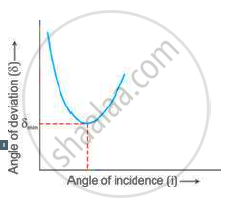
Draw an í- `delta` graph for a mono chromatic raY through a glass prism of a plane and mark
(i) `delta` m, the angle of mínimum devíation
(íí) Any two values of i for which value of `delta` ís same.
Fig shows a lens as a combination of a glass block and two prisms.

(i) Name the lens formed by the combination.
(ii) what is the XX' called?
(iii) Complete the ray diagram and show the path of the incident ray PQ after passing through the lens.
(iv) The final emergent ray will either meet XX' at a point or appear to come from a point on XX'. what is the point called?
Fig shows a lens as a combination of a glass block and two prisms.
(i) Name the lens formed by the combination.
(ii) What is the line XX' called?
(iii) Complete the path of the incident ray PQ after passing through the lens.
(iv) The final emergent ray either meets XX' at a point or appears to come from a point on XX'. Label it as F, What is this point called?
Draw a diagram to show the splitting of white light into its constituent colours.
Fig. shows a ray of white light that passes through a prism and produces a spectrum.
(a) Name the phenomenon that is taking place.
(b) What colour would you see at X and Y?
(c) What radiation would you detect above X and below Y?

Make the correct for each of the following :
With reference to the fig, the refractive index of the glass block is

Light of a single colour is passed through a liquid having a piece of glass suspended in it. On changing the temperature of liquid, at a particular temperature, the glass piece is not seen.
Why is the light of a single colour used ?
The critical angle for glass-air interface is :
Rewrite the following statement by selecting the correct option:
If a ray of light strikes a glass slab at an angle of 600 with the surface of the slab, the angle of incidence must be __________________.
During sunset and sunrise, the sun is seen when it is slightly below the horizon. Give reason.
A glass slab is placed over a page on which the word VIBGYOR is printed with each letter in its corresponding colour.
- Will the image of all the letters be in the same place?
- If not, the state which letter will be raised to the maximum. Give a reason for your answer.
Can the absolute refractive index of a medium be less than one?
The refractive index of air with respect to glass is defined: as gµa = sin i/sin r
If r = 90°, what is the corresponding angle i called?
Draw ray of light bending towards the normal while passing from air to glass. Label your diagrams.
Draw ray of light bending towards the normal while passing from glass to water. Label your diagrams.
How does the angle of deviation produced by a prism depend on the angle of incidence of light at the prism surface? Draw a graph to illustrate your answer.
How will you verify the laws of refraction or how the refractive index of glass is determined in the laboratory?
Explain with the help of a diagram of how fish is able to see the objects above it.
Draw a diagram of a prism and label:
(i) the base,
(ii) the refracting surfaces,
(iii) the refracting edge,
(iv) the refracting angle in it.
A ray of light PQ is incident normally on the hypotenuse of a right-angled prism ABC as shown in the diagram given below:

(i) Copy the diagram and complete the path of the ray PQ till it emerges from the prism.
(ii) What is the value of the angle of deviation of the ray?
(iii) Name an instrument where this action of the prism is used.
The velocity of light in diamond is 121000 kms-1. What is its refractive index?
A glass block is having refractive index 3/2, the light ray is incident at an angle 45°. Find the sine of the angle of, refraction inside the glass block.
A ray of light strikes the surface of a rectangular glass slab such that the angle of incidence in air is
- 0°,
- 45°.
In each case, draw a diagram to show the path taken by the ray as it passes through the glass slab and emerges from it.