Advertisements
Advertisements
Question
Advertisements
Solution

APPEARS IN
RELATED QUESTIONS
A student traces the path of a ray of light passing through a rectangular glass slab and marks the angle of incidence i, angle of refraction r and angle of emergence e, as shown.
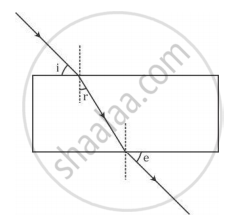
The correctly marked angle(s) is/are
(A) ∠ i only
(B) ∠ e only
(C) ∠ r only
(D) ∠ i and ∠ e
How does the speed of light change when it passes from glass to water?
Select from the following the best experimental set-up for tracing the path of a ray of light through a glass slab: (A) I
(A) I
(B) II
(C) III
(D) IV
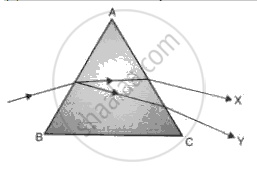
Fig. shows a ray of white light that passes through a prism and produces a spectrum.
(a) Name the phenomenon that is taking place.
(b) What colour would you see at X and Y?
(c) What radiation would you detect above X and below Y?
Name one main factor on which the direction of bending of a ray of light depends.
Define the term refractive index of a medium in terms of velocity of light.
Why does the sun appear bigger during sunset or sunrise?
In what condition a prism is said to be in the position of minimum deviation? What is the direction of the refracted ray inside the prism in this condition?
Consider these indices of refraction: glass: 1.52; air: 1.0003; water: 1.333. Based on the refractive indices of three materials, arrange the speed of light through them in decreasing order.
