Advertisements
Advertisements
Questions
Write the basic cause of refraction of light.
Advertisements
Solution
APPEARS IN
RELATED QUESTIONS
When a ray of light travels from air to glass slab and strikes the surface of separation at 90°, then it …………….
(a) bends towards normal
(b) bends away from normal
(c) passes unbent
(d) passes in zigzag way
Explain how spectrum is formed.
What is a spectrum?
How must light travel out of a substance if it is not going to be refracted?
Draw diagrams to show the refraction of light from
- air to glass, and
- glass to air. In each diagram, label the incident ray, refracted ray, the angle of incidence
- and the angle of refraction (r).
A monochromatic ray of light passes from air to glass. The wavelength of light in air is λ, the speed of light in air is c and in glass is V. If the absolute refractive index of glass is 1.5, write down
- the relationship between c and V,
- the wavelength of light in glass.
How does the speed of light change when it passes from glass to water?
What is meant by the statement the critical angle for diamond is 24°?
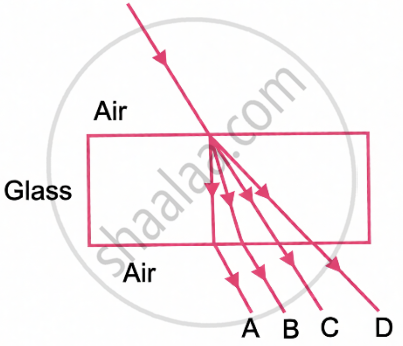
In the fig. name the ray which represents the correct path of light while passing through a glass block.
Draw an í- `delta` graph for a mono chromatic raY through a glass prism of a plane and mark
(i) `delta` m, the angle of mínimum devíation
(íí) Any two values of i for which value of `delta` ís same.
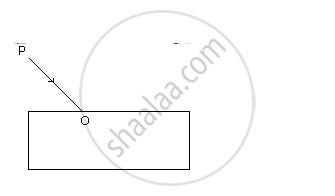
In the fig., PO is a ray of light incident on a rectangular glass block.
(a) Complete the path of the ray through the block.
(b) In the diagram, mark the angle of incidence (i) and the angle of refraction (r) at the first interface. How is the refractive index of glass related to the angles I and r?
(c) Mark angle of emergence by the letter e. How are the angles i and e related?
(d) Which two rays are parallel to each other? Name them.
(e) Indicate in the diagram the lateral displacement between the emergent ray and the incident ray.
State the factors on which the angle of deviation depends.
Name two instruments of the total refracting prism in which is used.
In the diagram below, PQ is a ray of light incident on a rectangular glass block.

How are the angles ‘i’ and ‘e’ related to each other?
The speed of light in air is 3 × 10⁸ ms-1. Calculate the speed of light in water. The refractive index of water is 4/3.
The refractive index of glass with respect to air is 1.5. What is the value of the refractive index of air with respect to glass?
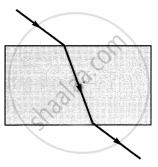
The path of a ray of light coming from air passing through a rectangular glass slab traced by four students are shown as A, B, C and D in the figure. Which one of them is correct?
 |
 |
 |
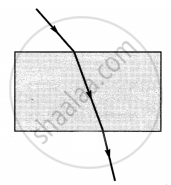 |
| A | B | C | D |
Draw the ray diagram of a glass slab having medium A and B for the velocity of light ray VA and VB respectively and define Snell's law.
- If VB = 1.5 VA, then which medium is denser?
- What is the refractive index of A with respect to B?
- What is the refractive index of B with respect to A?
