Advertisements
Advertisements
Questions
-
- the angle of refraction and
- the angle of deviation for the ray?
A ray of light is incident normally on a plane glass slab. What will be the angle of refraction and the angle of deviation for the ray?
Advertisements
Solution
The ray of light which is incident normally on a plane glass slab passes undeviated. That is such a ray suffers no bending at the surface because here the angle of incidence is 0°. Thus if angle of incidence ∠i = 0°, then the angle of refraction ∠r = 0°. And the angle of deviation of the ray will also be 0°.
RELATED QUESTIONS
Which colour of light travels fastest in any medium except air?
A ray of light passes from glass into air. The angle of refraction will be:
(a) equal to the angle of incidence
(b) greater than the angle of incidence
(c) smaller than the angle of incidence
(d) 45°
How does the angle of minimum deviation produces by a prism change with increase in :
the wavelength of incident light
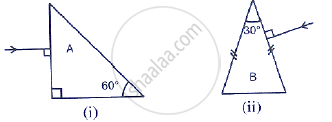
Fig 4.31 below shows a light ray of single colour incident normally on two prisms A and B. In each case draw the path of the ray of light as it enters and emerges out of the prism. Mark the angle wherever necessary.
Four students A, B, C and D traced the paths of incident ray and the emergent ray by fixing pins P and Q for incident ray and pins R and S for emergent ray for a ray of light passing through a glass slab.

The correct emergent ray was traced by the student:
(1) A
(2) B
(3) C
(4) D
A ray of light passes from air to water. In fig., which of the ray A, B, C and D is the correct refracted ray?
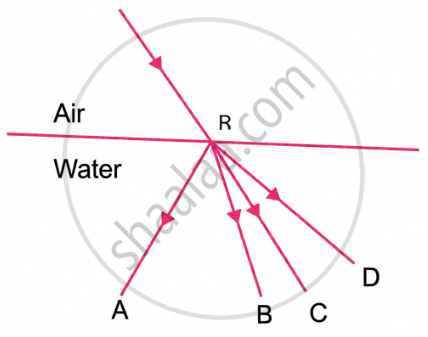
Fig shows a lens as a combination of a glass block and two prisms.
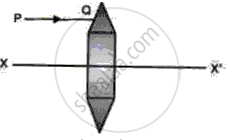
(i) Name the lens formed by the combination.
(ii) what is the XX' called?
(iii) Complete the ray diagram and show the path of the incident ray PQ after passing through the lens.
(iv) The final emergent ray will either meet XX' at a point or appear to come from a point on XX'. what is the point called?
Explain briefly what causes the twinkling of stars at night.
A ray of light is incident at an angle of 45° on one face of a rectangular glass slab of thickness 10 cm and refractive index 3/2. Calculate the lateral shift produced ______.
