Advertisements
Advertisements
प्रश्न
-
- the angle of refraction and
- the angle of deviation for the ray?
A ray of light is incident normally on a plane glass slab. What will be the angle of refraction and the angle of deviation for the ray?
Advertisements
उत्तर
The ray of light which is incident normally on a plane glass slab passes undeviated. That is such a ray suffers no bending at the surface because here the angle of incidence is 0°. Thus if angle of incidence ∠i = 0°, then the angle of refraction ∠r = 0°. And the angle of deviation of the ray will also be 0°.
संबंधित प्रश्न
Four students P, Q, R and S traced the path of a ray of light passing through a glass slab for an angle of incidence 40° and measured the angle of refraction. The values as measured them were 18°; 22°; 25° and 30° respectively. The student who has performed the experiment methodically is
(A) P
(B) Q
(C) R
(D) S
How is the reflection of light ray from a plane mirror different from the refraction of light ray as it enters a block of glass?
Write the relation between the angle of incidence and the angle of refraction for a medium.
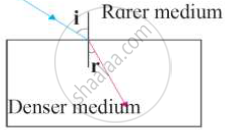
Observe the figure and write accurate conclusion regarding refraction of light.
In an experiment of finding the refractive index of glass, if blue light is replaced by the red light, how will the refractive index of glass change? Give reason in support of your answer.
The critical angle for glass-air interface is :
Choose the correct alternative and rewrite the following:
A glass slab is placed in the path of convergent light. The point of convergence of light
The refractive index of air with respect to glass is defined: as gµa = sin i/sin r
Write down a similar expression for aµg in terms of angle i and r.
Draw ray of light bending towards the normal while passing from glass to water. Label your diagrams.
Draw a diagram of a prism and label:
(i) the base,
(ii) the refracting surfaces,
(iii) the refracting edge,
(iv) the refracting angle in it.
