हिंदी

Observe the Figure and Write Accurate Conclusion Regarding Refraction of Light. - Science and Technology 1

Advertisements
Advertisements

प्रश्न

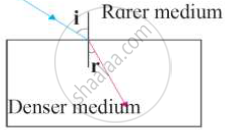
Observe the figure and write accurate conclusion regarding refraction of light.
Advertisements

उत्तर

When a light ray passes from a rarer medium to a denser medium, it bends towards the normal.

shaalaa.com
  क्या इस प्रश्न या उत्तर में कोई त्रुटि है?
2018-2019 (March) Balbharati Model Question Paper Set 1

संबंधित प्रश्न

A student traces the path of a ray of light through a rectangular glass slab for the different values of angle of incidence. He observes all possible precautions at each step of the experiment. At the end of the experiment, on analyzing the measurements, which of the following conclusions is he likely to draw?

(A) ∠i = ∠e < ∠r

(B) ∠i < ∠e < ∠r

(C) ∠i > ∠e > ∠r

(D) ∠i = ∠e > ∠r


If the speed of light in vacuum is 3 × 10⁸ ms−1, find the speed of light in a medium of absolute refractive index 1.5.


State the dependence of angle of deviation On the refractive index of the material of the prism.


Name one factor that affects the lateral displacement of light as it passes through a rectangular glass slab.


The speed of light in glass is 2 × 10⁵ km/s. What is the refractive index of glass?


A ray of light passes from water to air. How does the speed of light change?


Name a prism required for obtaining a spectrum of Ultraviolet light.


Why is the ratio of the velocities of light of wavelengths 4000Å and 8000Å in vacuum 1: 1?


Which of the above wavelengths has a higher frequency?


Observe the following figure and answer the questions given under it:

1) How many times does refraction take place in the above figure?

2) What happens to the ray of light when it passes from air to glass?

3) What happens to the ray of light when it passes from glass to air?

4) What are the rays AB and CD in the figure called?

5) Define refraction.


A ray of light passes from glass into air. The angle of refraction will be:

(a) equal to the angle of incidence
(b) greater than the angle of incidence
(c) smaller than the angle of incidence
(d) 45° 


Write the relation between the angle of incidence and the angle of refraction for a medium.


A ray of light strikes the surface of a rectangular glass block such that the angle of incidence in
air is  0°.
In each case, draw diagram to show the path taken by the ray as it passes through the glass block and emerges from it. 


Light of a single colour is passed through a liquid having a piece of glass suspended in it. On changing the temperature of liquid, at a particular temperature the glass piece is not seen. When is the glass piece not seen?


A ray of light is passing from a transparent medium 1 to another transparent medium 2 (i) Speed up (ii) slows down. In each case, state whether the refractive index of medium 2 is equal to, less than or greater than the refractive index of medium 1. 


What is meant by the statement the critical angle for diamond is 24°?


The refractive index of air with respect to glass is expressed as `""_g μ_a=sin i /sin r`.

  1. Write down a similar expression for aμg in terms of the angles i and r.
  2. If angle r = 90°, what is the corresponding angle i called?
  3. What is the physical significance of the angle i in part (b)? 

A ray of light enters a glass slab ABDC as shown in figure and strikes at the centre O of the circular part AC of the slab. The critical angle of glass is 42°. Complete the path of the ray till it emerges out from the slab. Mark the angles in the diagram wherever necessary. 


Trace the path of a ray of light incident at an angle of 45° on a rectangular glass slab. Write the measure of the angle of refraction, the angle of emergence and the lateral displacement suffered by the ray as it passes through the slab. 


After tracing the path of rays of light through a glass slab for three different angles of incidence, a student measured the corresponding values angle of refraction r and angle of emergence e and recorded them in the table given below: 

S. No.

i

i

e

I

30°

20°

31°

II

40°

25°

40°

III

50°

31°

49°

The correct observations are:

(A) I and II

(B) II and III

(C) I and III

(D) I, II and III


While tracing the path of a ray of light passing through a rectangular glass slab a student tabulated his observations as given below:

S.NO.

∠i

∠r

∠e

I

60°

40°

61°

II

50°

36°

51°

III

40°

28°

39°

IV

30°

20°

31°

The correct observations is:

(A) I

(B) II

(C) III

(D) IV


Four students showed the following traces of the path of a ray of light passing through a rectangular glass slab.


The trace most likely to be correct is that of student

(A) I

(B) II

(C) III

(D) IV


Rahim recorded the following sets of observations while tracing the path of a ray of light passing through a rectangular glass slab for different angles of incidence.

S. No.

Angle of incidence

Angle of refraction

Angle of emergence

I

45°

41°

45°

II

40°

38°

38°

III

45°

41°

40°

IV

41°

45°

41°

The correct observation is recorded at serial number: 

(1) I

(2) II 

(3) III 

(4) IV 


Does reflection also take place with the refraction?

What is the cause of refraction of light?

For which colour of white light, is the refractive index of a transparent medium the least?

A ray of light passes from air to water. In fig. 39, which of the ray A, B, C and D is the correct refracted ray?


Which of the following has the highest refractive index:


Can you guess the focal length of a plane mirror?

Make the correct for each of the following : 

With reference to the fig, the refractive index of the glass block is 


In an experiment of finding the refractive index of glass, if blue light is replaced by the red light, how will the refractive index of glass change? Give reason in support of your answer.


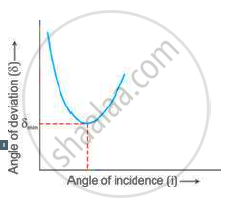
Using the curve, how do you infer that for given prism, the angle of minimum deviation δmin is unique for the given light?

Does the depth of a tank of water appear to change or remain the same when viewed normally from above?


Two parallel rays of Red and Violet travelling through the air, meet the air-glass boundary as shown in the above figure. Will their paths inside the glass be parallel? Give a reason for your answer.


The diagram shows the path of a ray of light through a rectangular glass block placed in a liquid of uniform density.

(a) Does the light speed up or slow down in the glass,
(b) Give the reason for your answer.


The speed of light in air is 3 × 10ms-1. Calculate the speed of light in water. The refractive index of water is 4/3.


A glass block is having refractive index 3/2, the light ray is incident at an angle 45°. Find the sine of the angle of, refraction inside the glass block.


A coin placed at the bottom of a beaker appears to be raised by 4.0 cm. If the refractive index of water is 4/3, find the depth of the water in the beaker.


Share
Notifications

Englishहिंदीमराठी


      Forgot password?
Use app×