Advertisements
Advertisements
प्रश्न
What is meant by the refraction of light?
Advertisements
उत्तर
It is a phenomenon in which a ray of light deviates from its original path while travelling from one optical medium to another optical medium.
APPEARS IN
संबंधित प्रश्न
Explain how the formation of a rainbow occurs.
The speed of light in glass is 2 × 10⁵ km/s. What is the refractive index of glass?
Fig 4.31 below shows a light ray of single colour incident normally on two prisms A and B. In each case draw the path of the ray of light as it enters and emerges out of the prism. Mark the angle wherever necessary.
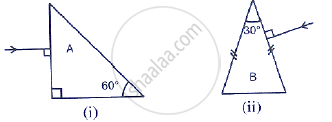
Fig shows a lens as a combination of a glass block and two prisms.
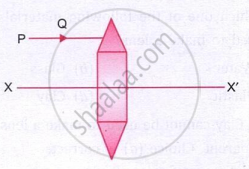
- Name the lens formed by the combination.
- What is the line XX' called?
- Complete the path of the incident ray PQ after passing through the lens.
- The final emergent ray either meets XX' at a point or appears to come from a point on XX'. Label it as F, What is this point called?
A ray of light strikes the surface at a rectangular glass slab such that the angle of incidence is 45o.
In each case, draw diagram to show the path taken by the ray as it passes through the glass slab and emerges from it.
How is the refractive index of a medium related to its real depth and apparent depth?
Explain briefly what causes the twinkling of stars at night.
Trace a ray of light incident at 30° on a surface if travelling from air to glass. What is the angle of refraction in this case? (R.I. for glass = 3/2).
A coin placed at the bottom of a beaker appears to be raised by 4.0 cm. If the refractive index of water is 4/3, find the depth of the water in the beaker.
