Advertisements
Advertisements
प्रश्न
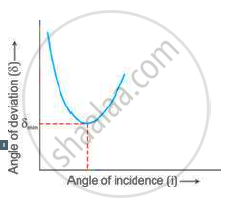
How does the angle of deviation produced by a prism change with increase in the angle of incidence. Draw a curve showing the variation in the angle of deviation with the angle of incidence at a prism surface.
Advertisements
उत्तर १
As the angle of incidence increases, the angle of deviation decreases first and reaches to a minimum value (δm) for a certain angle of incidence. By further increasing the angle of incidence, the angle of deviation is found to increase.
Variation of angle of deviation (δ) with angle of incidence(i):
उत्तर २
The deviation angle first increases with increasing incidence angle and then decreases. From figure,
δ = δ1 + δ2 ....(i)
and i = δ1 +γ1 ; e = δ2 +γ2
⇒ i = γ1 = δ1 ....(ii)
⇒ e - γ1 = δ2 ....(iii)
from ΔON1 N2
γ1 +γ2 + ∠N1 ON2=180° ....(iv)
from cyclic quadrilateral
∠A + ∠N1ON2 = 180° ....(v)
from (iv) and (v)
γ1 +γ2 = A
δ = i - γ1 + e - γ2
=( i - e) - (γ1 + γ2) ...(vi)
at δm ;
i = e ; γ1 = γ2= γ
δm =2i - A ...(vii)
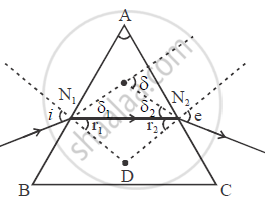
The variation in the angle of deviation with the angle of incidence at a prism surface
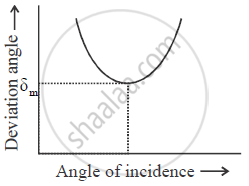
Graph between i and δm
संबंधित प्रश्न
After tracing the path of a ray of light passing through a rectangular glass slab for four different values of the angle of incidence, a student reported his observations in tabular form as given below:
| S.No | ∠ i | ∠ r | ∠ e |
| I | 30° | 19° | 29° |
| II | 40° | 28° | 40° |
| III | 50° | 36° | 50° |
| IV | 60° | 40° | 59° |
The best observation is
(A) I
(B) II
(C) III
(D) IV
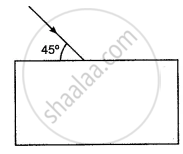
Draw the diagram given below and clearly show the path taken by the emergent ray.
With the help of diagram of the principal section of a prism, indicate its refracting surfaces, refracting edge and base.
How does the speed of light change when it passes from glass to water?
Select from the following the best set-up for tracing the path of a ray of light through a rectangular glass slab:

(A) I
(B) II
(C) III
(D) IV
During sunset and sunrise, the sun is seen when it is slightly below the horizon. Give reason.
How is the refractive index of a medium related to its real depth and apparent depth?
In the diagram below, PQ is a ray of light incident on a rectangular glass block.

Copy the diagram and complete the path of the ray of light through the glass block. In your diagram, mark the angle of incidence by letter ‘i’ and the angle of emergence by the letter ‘e’.
In the diagram alongside a ray of light, PQ is incident normally on one face AB of an equilateral glass prism. What is the angle of incidence at the faces AB and AC?

