Advertisements
Advertisements
प्रश्न
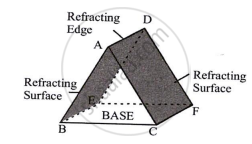
With the help of diagram of the principal section of a prism, indicate its refracting surfaces, refracting edge and base.
Advertisements
उत्तर
The refracting edge and base are shown in the figure.
APPEARS IN
संबंधित प्रश्न
State the dependence of angle of deviation on the refractive index of the material of the prism.
Observe the following figure and answer the questions given under it:

1) How many times does refraction take place in the above figure?
2) What happens to the ray of light when it passes from air to glass?
3) What happens to the ray of light when it passes from glass to air?
4) What are the rays AB and CD in the figure called?
5) Define refraction.
When a ray of light from air enters a denser medium, it ______.
What is meant by the statement the critical angle for diamond is 24°?
The refractive index of glass is 1.5. From a point P inside a glass block, draw rays PA, PB and PC incident on the glass air surface at an angle of incidence 30°, 42° and 60° respectively.
- In the diagram show the approximate direction of these rays as they emerge out of the block.
- What is the angle of refraction for the ray PB?
`("Take" sin 42° =2/3)`
A student has traced the path of a ray of light through a glass slab as follows. If you are asked to label 1, 2, 3 and 4, the correct sequencing of labeling ∠i, ∠e, ∠r and lateral displacement respectively is
(a) 2, 1, 3, 4
(b) 1, 2, 3, 4
(c) 1, 3, 2, 4
(d) 1, 3, 4, 2
Why does a fisherman aim at the tail of fish during spearfishing?
During sunset and sunrise, the sun is seen when it is slightly below the horizon. Give reason.
A ray of light moves from a rare medium to a dense medium as shown in the diagram below. Write down the number of the ray which represents the partially reflected ray.

The refractive index of glass with respect to air is 3/2. What is the refractive index of air with respect to glass?
