Advertisements
Advertisements
प्रश्न
In the diagram alongside a ray of light, PQ is incident normally on one face AB of an equilateral glass prism. What is the angle of incidence at the faces AB and AC?

Advertisements
उत्तर
∠ of incidence of face AB = 60°
∠ of incidence of face AC = 60°
संबंधित प्रश्न
Define refraction and state the laws of refraction.
Explain how the formation of a rainbow occurs.
In your laboratory you trace the path of light rays through a glass slab for different values of angle of incidence (∠i) and in each case measure the values of the corresponding angle of refraction (∠r) and angle of emergence (∠e). On the basis of your observations your correct conclusion is:
(a) ∠i is more than ∠r, but nearly equal to ∠e
(b) ∠i is less then ∠r, but nearly equal to ∠e
(c) ∠i is more than ∠e, but nearly equal to ∠r
(d) ∠i is less than ∠e, but nearly equal to ∠r
Explain the term absolute refractive index of a medium and write an expression to relate it with the speed of light in vacuum.
How does the angle of minimum deviation produces by a prism change with increase in :
the refracting angle of prism?
Name the colour of white light which is deviated the most on passing through a prism.
Fig shows a lens as a combination of a glass block and two prisms.
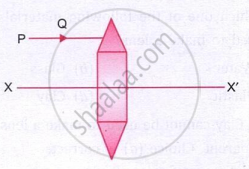
- Name the lens formed by the combination.
- What is the line XX' called?
- Complete the path of the incident ray PQ after passing through the lens.
- The final emergent ray either meets XX' at a point or appears to come from a point on XX'. Label it as F, What is this point called?
Express the refractive index μ of a medium in terms of the velocity of light.
The refractive index of glass with respect to air is 1.5. What is the value of the refractive index of air with respect to glass?
