Advertisements
Advertisements
प्रश्न
In the diagram alongside a ray of light, PQ is incident normally on one face AB of an equilateral glass prism. What is the angle of incidence at the faces AB and AC?

Advertisements
उत्तर
∠ of incidence of face AB = 60°
∠ of incidence of face AC = 60°
संबंधित प्रश्न
If the speed of light in vacuum is 3 × 10⁸ ms−1, find the speed of light in a medium of absolute refractive index 1.5.
A ray of light passes from glass into air. The angle of refraction will be:
(a) equal to the angle of incidence
(b) greater than the angle of incidence
(c) smaller than the angle of incidence
(d) 45°
The highest refractive index is of ______.
With the help of diagram of the principal section of a prism, indicate its refracting surfaces, refracting edge and base.
How does the angle of deviation produced by a prism change with increase in the angle of incidence. Draw a curve showing the variation in the angle of deviation with the angle of incidence at a prism surface.
A coin is places at the bottom of a beaker containing water (refractive index = 4/3) to a depth of 12 cm. By what height the coin appears to be raised when seen from vertically above?
The refractive index of air with respect to glass is expressed as `""_g μ_a=sin i /sin r`.
- Write down a similar expression for aμg in terms of the angles i and r.
- If angle r = 90°, what is the corresponding angle i called?
- What is the physical significance of the angle i in part (b)?
Make the correct for each of the following :
With reference to the fig, the refractive index of the glass block is
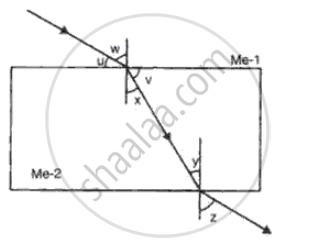
What is the refractive index of vacuum
State the relation between the refractive index μ and the velocity of light (vm) in that medium.
