Advertisements
Advertisements
प्रश्न
Fig shows a lens as a combination of a glass block and two prisms.
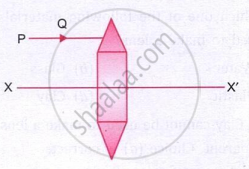
- Name the lens formed by the combination.
- What is the line XX' called?
- Complete the path of the incident ray PQ after passing through the lens.
- The final emergent ray either meets XX' at a point or appears to come from a point on XX'. Label it as F, What is this point called?
Advertisements
उत्तर
- It is a convex (converging) lens.
- XX′ is the principal axis.

Since PQ is parallel to the principal axis, after refraction it passes through the principal focus on the other side of the convex lens.- The point is the principal focus (second principal focus).
APPEARS IN
संबंधित प्रश्न
Why is the ratio of the velocities of light of wavelengths 4000Å and 8000Å in vacuum 1: 1?
Draw diagrams to show the refraction of light from glass to air. In diagram, label the incident ray, refracted ray, the angle of incidence (i) and the angle of refraction (r).
How does the speed of light change when it passes from glass to water?
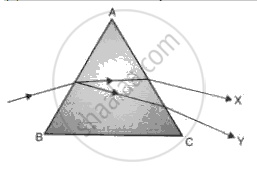
Fig. shows a ray of white light that passes through a prism and produces a spectrum.
(a) Name the phenomenon that is taking place.
(b) What colour would you see at X and Y?
(c) What radiation would you detect above X and below Y?
In an experiment of finding the refractive index of glass, if blue light is replaced by the red light, how will the refractive index of glass change? Give reason in support of your answer.
Light of a single colour is passed through a liquid having a piece of glass suspended in it. On changing the temperature of liquid, at a particular temperature, the glass piece is not seen.
Why is the light of a single colour used ?
Does the depth of a tank of water appear to change or remain the same when viewed normally from above?
Trace a ray of light incident at 30° on a surface if travelling from air to glass. What is the angle of refraction in this case? (R.I. for glass = 3/2).
Explain with the help of a diagram of how fish is able to see the objects above it.
