Advertisements
Advertisements
प्रश्न
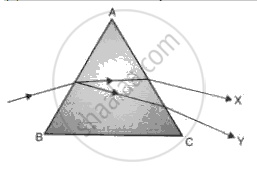
Fig. shows a ray of white light that passes through a prism and produces a spectrum.
(a) Name the phenomenon that is taking place.
(b) What colour would you see at X and Y?
(c) What radiation would you detect above X and below Y?
Advertisements
उत्तर
(a) Dispersion
(b) Red colour at X and violet colour at Y.
(c) Above X, we would detect infra-red radiation and below Y, ultra-violet radiation.
APPEARS IN
संबंधित प्रश्न
State the dependence of angle of deviation on the wavelength of light
Name one factor that affects the lateral displacement of light as it passes through a rectangular glass slab.
How is the refractive index of a medium related to the speed of light in it?
What do you understand by the statement the refractive index of glass is 1.5 for white light?
While performing the experiment on tracing the path of a ray of light through a rectangular glass slab, in which of the following experimental set-ups is a student likely to get best results? P1 and P2 are the positions of pins fixed by him.
(A) I
(B) II
(C) III
(D) IV
How does the deviation produced by a prism depend on the wavelength of incident light?
State the factors on which the angle of deviation depends.
Name the material for which the refractive index is found to be maximum.
Complete the ray diagram showing its emergence into the air after passing through the prism.

