Advertisements
Advertisements
प्रश्न
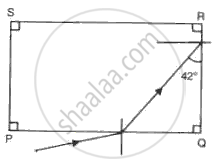
(a) A ray of monochromatic light enters glass PQRS as shown in the fig. Complete the path of ray till it emerges from the glass. (Critical angle of glass is 420).
(b) Draw diagram of a prism periscope.
(c) What are the advantages of total internal reflecting prism over plane mirror?
Advertisements
उत्तर

Note : here that when the angle of incidence in the denser medium is more than the critical angle (= 42), then the ray undergoes total internal reflection.
At angle of incidence equal to critical angle, the ray grazes the interface.
(b) Diagram of prism periscope:

(c) In case of reflection from plane mirror, all of light in not reflected. In case of total reflecting prism, all rays failing beyond critical angle will be totally reflected. The intensity of reflected light is equal to the intensity of incident light in case of total internal ref;lection but not in case of reflection from plane mirror.
In addition, the reflection through a thick mirror causes multiple image formation as well as lateral inversion of image.
Due to the above two reasons, the total reflecting prisms are preferred over the plane mirrors.
APPEARS IN
संबंधित प्रश्न
State two conditions necessary for total internal reflection to occur.
Write down the relationship between the critical angle and the refractive index of the medium.
The adjacent diagram shows two right-angled isosceles prisms A and B. Complete the diagram to show the path of rays P and Q emerging out of the prism B. What principles have you used to complete the diagram?

Answer the following question.
Define the critical angle of incidence and obtain an expression for it.
Answer the following question.
Why is prism binoculars preferred over traditional binoculars? Describe its working in brief.
For total internal reflection to take place, the angle of inddence i and the refractive index µ of the medium must satisfy the inequality ____________.
What are the conditions to achieve total internal reflection?
A ray of light passes through a prism of refractive index `sqrt2` as shown in the figure. Find:
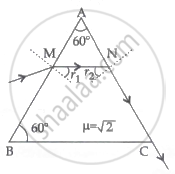
- The angle of incidence (∠r2) at face AC.
- The angle of minimum deviation for this prism.
Which of the following is used in optical fibres?
When the angle of incidence for light travelling from a denser medium to a rarer medium is greater than the critical angle, the result is:
