Advertisements
Advertisements
Question
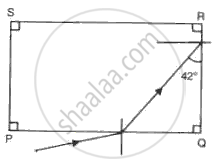
(a) A ray of monochromatic light enters glass PQRS as shown in the fig. Complete the path of ray till it emerges from the glass. (Critical angle of glass is 420).
(b) Draw diagram of a prism periscope.
(c) What are the advantages of total internal reflecting prism over plane mirror?
Advertisements
Solution

Note : here that when the angle of incidence in the denser medium is more than the critical angle (= 42), then the ray undergoes total internal reflection.
At angle of incidence equal to critical angle, the ray grazes the interface.
(b) Diagram of prism periscope:

(c) In case of reflection from plane mirror, all of light in not reflected. In case of total reflecting prism, all rays failing beyond critical angle will be totally reflected. The intensity of reflected light is equal to the intensity of incident light in case of total internal ref;lection but not in case of reflection from plane mirror.
In addition, the reflection through a thick mirror causes multiple image formation as well as lateral inversion of image.
Due to the above two reasons, the total reflecting prisms are preferred over the plane mirrors.
APPEARS IN
RELATED QUESTIONS
Which colour of light has a higher critical angle? Red light or green light.
The observation made by Swarali while doing the experiment is given below. Based on these write answers to the questions:
Swarali found that the light ray travelling from the denser medium to rarer medium goes away from the normal. If the angle of incidence (i) is raised by Swarali, the angle of refraction (r) went on increasing. However, after certain value of the angle of incidence the light ray is seen to return back into the denser medium.
Questions:
- What is the specific value of∠i called?
- What is the process of reflection of incident rays into denser medium called?
- Draw the diagrams of three observations made by Swarali.
Define critical angle for a given medium.
Name the factors affecting the critical angle for the pair of media.
Complete the following diagram to show the path of the ray of a single colour in the diagram as if enters in and emerges out of the prism. Mark the angles wherever necessary. (Critical angle for glass = 42°).

PQ and PR are two light rays emerging from the object as shown in the figure below:

(i) What is the special name given to the angle of incidence (∠PQN) of ray PQ?
(ii) Copy the ray diagram and complete it to show the position of the image of the object P when seen obliquely from above.
(iii) Name the phenomenon that occurs if the angle of incidence ∠PQN is increased still further.
The entire light is reflected back into the denser medium is called ______.
A green light is incident from the water to the air-water interface at the critical angle (θ). Select the correct statement.
State the condition under which total internal reflection occurs. Give the mathematical expression for total internal reflection.
The critical angle for crown glass, which has a refractive index of 1.52, is:
