Advertisements
Advertisements
Question
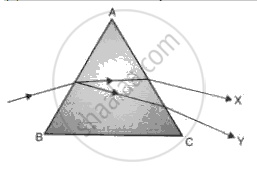
Fig. shows a ray of white light that passes through a prism and produces a spectrum.
(a) Name the phenomenon that is taking place.
(b) What colour would you see at X and Y?
(c) What radiation would you detect above X and below Y?
Advertisements
Solution
(a) Dispersion
(b) Red colour at X and violet colour at Y.
(c) Above X, we would detect infra-red radiation and below Y, ultra-violet radiation.
APPEARS IN
RELATED QUESTIONS
Name a prism required for obtaining a spectrum of Ultraviolet light.
Which of the above wavelengths has a higher frequency?
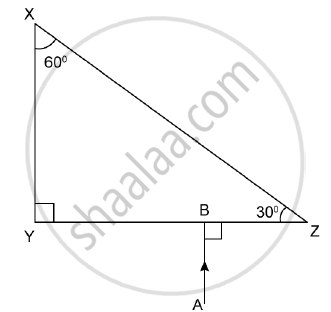
The following diagram shows a 60°, 30°, 90° glass prism of critical angle 42°, Copy the diagram and complete the path of incident ray AB emerging out of the prism marking the angle of incidence on each surface.
When a ray of light from air enters a denser medium, it ______.
A total reflecting right angled isosceles prism can be used to deviate a ray of light through:
(a) 30° (b) 60° (c) 75° (d) 90°.
Four students A, B, C and D traced the paths of incident ray and the emergent ray by fixing pins P and Q for incident ray and pins R and S for emergent ray for a ray of light passing through a glass slab.

The correct emergent ray was traced by the student:
(1) A
(2) B
(3) C
(4) D
In an experiment of finding the refractive index of glass, if blue light is replaced by the red light, how will the refractive index of glass change? Give reason in support of your answer.
The figure shows two prisms A and B. A monochromatic ray of light PO is incident at the face of the prism A. Complete the diagram to show the path of the ray till it emerges out of the prism B.

A ray of light strikes the surface of a rectangular glass slab such that the angle of incidence in air is
- 0°,
- 45°.
In each case, draw a diagram to show the path taken by the ray as it passes through the glass slab and emerges from it.
