Advertisements
Advertisements
प्रश्न
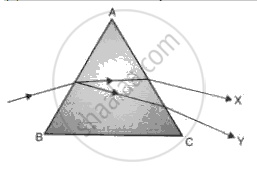
Fig. shows a ray of white light that passes through a prism and produces a spectrum.
(a) Name the phenomenon that is taking place.
(b) What colour would you see at X and Y?
(c) What radiation would you detect above X and below Y?
Advertisements
उत्तर
(a) Dispersion
(b) Red colour at X and violet colour at Y.
(c) Above X, we would detect infra-red radiation and below Y, ultra-violet radiation.
APPEARS IN
संबंधित प्रश्न
Draw a ray diagram to show the refraction of light through a glass slab and mark angle of refraction and the lateral shift suffered by the ray of light while passing through the slab.
Which colour of light travels fastest in any medium except air?
How can you bend light away from the normal?
A ray of light strikes the surface of a rectangular glass block such that the angle of incidence in
air is 0°.
In each case, draw diagram to show the path taken by the ray as it passes through the glass block and emerges from it.
-
- the angle of refraction and
- the angle of deviation for the ray?
What is meant by the refraction of light?
During sunset and sunrise, the sun is seen when it is slightly below the horizon. Give reason.
Can the absolute refractive index of a medium be less than one?
The refractive index of glass with respect to air is 3/2. What is the refractive index of air with respect to glass?
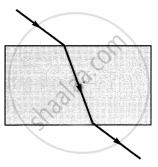
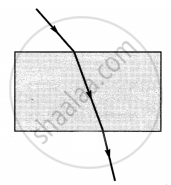
The path of a ray of light coming from air passing through a rectangular glass slab traced by four students are shown as A, B, C and D in the figure. Which one of them is correct?
 |
 |
 |
 |
| A | B | C | D |
