Advertisements
Advertisements
प्रश्न
-
- the angle of refraction and
- the angle of deviation for the ray?
A ray of light is incident normally on a plane glass slab. What will be the angle of refraction and the angle of deviation for the ray?
Advertisements
उत्तर
The ray of light which is incident normally on a plane glass slab passes undeviated. That is such a ray suffers no bending at the surface because here the angle of incidence is 0°. Thus if angle of incidence ∠i = 0°, then the angle of refraction ∠r = 0°. And the angle of deviation of the ray will also be 0°.
संबंधित प्रश्न
A student traces the path of a ray of light passing through a rectangular glass slab and marks the angle of incidence i, angle of refraction r and angle of emergence e, as shown.
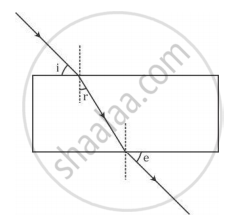
The correctly marked angle(s) is/are
(A) ∠ i only
(B) ∠ e only
(C) ∠ r only
(D) ∠ i and ∠ e
Why do we get a spectrum of seven colors when white light is dispersed by a prism?
Draw diagrams to show the refraction of light from
- air to glass, and
- glass to air. In each diagram, label the incident ray, refracted ray, the angle of incidence
- and the angle of refraction (r).
Light of a single colour is passed through a liquid having a piece of glass suspended in it. On changing the temperature of liquid, at a particular temperature the glass piece is not seen. When is the glass piece not seen?
Why does a fisherman aim at the tail of fish during spearfishing?
Calculate the velocity of light in a glass block of refractive index 1.5. (Velocity of light in air = 3 × 10⁸ m/s)

Which colour of white light travels fastest in any medium except air?
