Advertisements
Advertisements
प्रश्न
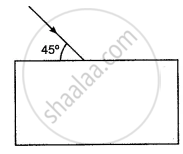
Draw the diagram given below and clearly show the path taken by the emergent ray.
Advertisements
उत्तर
ic = 42 for glass. The ray undergoes refraction as it emerges away from the slab.

APPEARS IN
संबंधित प्रश्न
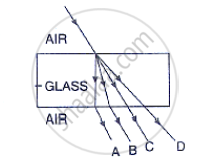
In fig 4.18, name the ray which represents the correct path of light while emerging out through a glass block.
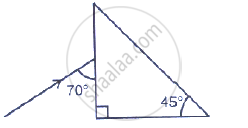
Complete Fig. 4.32 to show the path of the ray of single colour as it enters the prism and emerges out of it. Mark the angles wherever necessary.
After tracing the path of rays of light through a glass slab for three different angles of incidence, a student measured the corresponding values angle of refraction r and angle of emergence e and recorded them in the table given below:
|
S. No. |
∠i |
∠i |
∠e |
|
I |
30° |
20° |
31° |
|
II |
40° |
25° |
40° |
|
III |
50° |
31° |
49° |
The correct observations are:
(A) I and II
(B) II and III
(C) I and III
(D) I, II and III
Define the term refractive index of a medium. What do you understand by the statement 'the refractive index of glass is 1.5 for white light'?
A ray of light passes from water to air. How does the speed of light change?
The diagram shows the path of a ray of light through a rectangular glass block placed in a liquid of uniform density.

What is the angular, deviation of the emergent ray from the glass block with respect to the incident ray?
Trace a ray of light incident at 30° on a surface if travelling from air to glass. What is the angle of refraction in this case? (R.I. for glass = 3/2).
Which colour of white light travels fastest in any medium except air?
