Advertisements
Advertisements
प्रश्न
Define refraction and state the laws of refraction.
Advertisements
उत्तर
The phenomenon of change in the direction of propagation of light when it passes obliquely from one transparent medium to another is called refraction of light.
Laws of refraction:-
- The incident ray and the refracted ray are on the opposite sides of the normal at the point of incidence, and all three lie in the same plane.
- For a given pair of media, the ratio of the sine of the angle of incidence to the sine of the angle of refraction is constant.
`sin i/sin r=mu`
This constant is called the refractive index of the second medium with respect to the first medium.
APPEARS IN
संबंधित प्रश्न
In your laboratory you trace the path of light rays through a glass slab for different values of angle of incidence (∠i) and in each case measure the values of the corresponding angle of refraction (∠r) and angle of emergence (∠e). On the basis of your observations your correct conclusion is:
(a) ∠i is more than ∠r, but nearly equal to ∠e
(b) ∠i is less then ∠r, but nearly equal to ∠e
(c) ∠i is more than ∠e, but nearly equal to ∠r
(d) ∠i is less than ∠e, but nearly equal to ∠r
If the speed of light in vacuum is 3 × 10⁸ ms−1, find the speed of light in a medium of absolute refractive index 1.5.
Study the following four experimental set-ups I, II, III and IV for the experiment, "To trace the path of a ray of light through a rectangular glass slab."

Which of the marked set-ups is likely to give best results (P1 and P2 are the positions of pins fixed on the incident ray)?
(A) I
(B) II
(C) III
(D) IV
A student very cautiously traces the path of a ray through a glass slab for different values of the angle of incidence (∠i). He then measures the corresponding values of the angle of refraction (∠r) and the angle of emergence (∠e) for every value of the angle of incidence. On analysing these measurements of angles, his conclusion would be
(A) ∠i > ∠r > ∠e
(B) ∠i = ∠e > ∠r
(C) ∠i < ∠r < ∠e
(D) ∠i = ∠e < ∠r
How does the angle of minimum deviation produces by a prism change with increase in :
the refracting angle of prism?
What do you understand by the statement the refractive index of glass is 1.5 for white light?
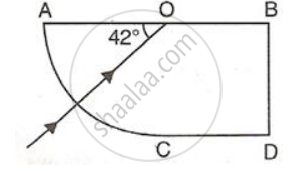
A ray of light enters a glass slab ABDC as shown in figure and strikes at the centre O of the circular part AC of the slab. The critical angle of glass is 42°. Complete the path of the ray till it emerges out from the slab. Mark the angles in the diagram wherever necessary.
Select from the following the best set-up for tracing the path of a ray of light through a rectangular glass slab:

(A) I
(B) II
(C) III
(D) IV
A student traces the path of a ray of white light through a rectangular glass slab and marks, the angles of incidence (∠i) , refraction (∠r) and emergence (∠e) as shown. Which angle or angles has he not marked correctly?

(A) ∠i only
(B) ∠i and ∠r
(C) ∠i and ∠e
(D) ∠r and ∠e
Define the term refractive index of a medium. What do you understand by the statement 'the refractive index of glass is 1.5 for white light'?
A ray of light passes from air to water. In fig., which of the ray A, B, C and D is the correct refracted ray?
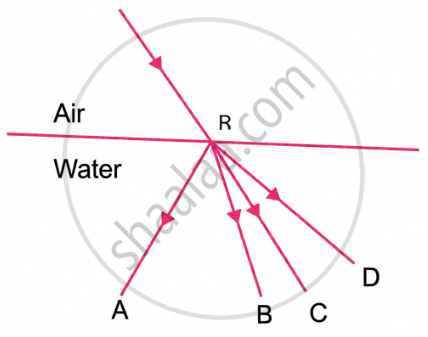
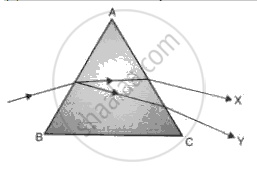
Fig. shows a ray of white light that passes through a prism and produces a spectrum.
(a) Name the phenomenon that is taking place.
(b) What colour would you see at X and Y?
(c) What radiation would you detect above X and below Y?
Which colour of light travels fastest in any medium except air?
How does the deviation produced by a prism depend on the wavelength of incident light?
Does the depth of a tank of water appear to change or remain the same when viewed normally from above?
The refractive index of glass with respect to air is 3/2. What is the refractive index of air with respect to glass?
A glass block is having refractive index 3/2, the light ray is incident at an angle 45°. Find the sine of the angle of, refraction inside the glass block.
Consider these indices of refraction: glass: 1.52; air: 1.0003; water: 1.333. Based on the refractive indices of three materials, arrange the speed of light through them in decreasing order.
