Advertisements
Advertisements
प्रश्न
With a neat labelled diagram and derive the equation for three resistances connected in parallel.
Advertisements
उत्तर
When two or more resistors are joined at the same end, the resistances are connected in parallel.
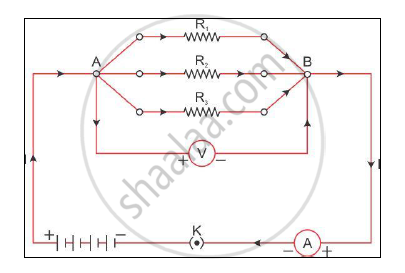
The potential difference in parallel remains the same across all the resistors.
The current is the sum of the currents across all the individual resistors.
l = l1 + l2 + l3 .........(1)
Let Rp be the resultant resistance of the circuit.
On applying Ohm’s law to the entire circuit, we get
l = V/Rp ................(2)
Now, applying Ohm’s law to individual resistances, we get
l1 = V/R1
l2 = V/R2
l3 = V/R3 ................(3)
From equations (1), (2) and (3), we get
`V/R_p=V/R_1+V/R_2+V/R_3`
`therefore1/R_p=1/R_1+1/R_2+1/R_3`
Here, Rp is the resultant resistance. Thus, the reciprocal of the resultant resistance of a parallel combination of resistors is the sum of the reciprocals of individual resistances. The resultant resistance is lesser than all the resistances.
APPEARS IN
संबंधित प्रश्न
An electric lamp of 100 Ω, a toaster of resistance 50 Ω, and a water filter of resistance 500 Ω are connected in parallel to a 220 V source. What is the resistance of an electric iron connected to the same source that takes as much current as all three appliances, and what is the current through it?
How can three resistors of resistances 2 Ω, 3 Ω and 6 Ω be connected to give a total resistance of 4 Ω ?
The equivalent resistance of the parallel combination of two resistors of 60Ω and 40Ω is _______.
A) 24Ω
(B) 100Ω
(C) 50 Ω
(D) 240Ω
An electric heater which is connected to a 220 V supply line has two resistance coils A and B of 24 Ω resistance each. These coils can be used separately (one at a time), in series or in parallel. Calculate the current drawn when:
(a) only one coil A is used.
(b) coils A and B are used in series.
(c) coils A and B are uses in parallel.
How will you connect three resistors of 2 Ω, 3 Ω and 5 Ω respectively so as to obtain a resultant of 2.5 Ω? Draw the diagram to show the arrangement.
Two resistors having resistance 4𝛀 and 6𝛀 are connected in parallel. Find their equivalent resistance.
A uniform wire with a resistance of 27 Ω is divided into three equal pieces and then they are joined in parallel. Find the equivalent resistance of the parallel combination.
What are the advantages of a parallel connection?
Explain, why is the p.d. between the terminals of a storage battery less when it is supplying current than when it is on open circuit. A battery of e.m.f. 10 volts and internal resistance 2.5 ohms has two resistances of 50 ohms each connected to it. Calculate the power dissipated in each resistance
(a) When they are in series,
(b) When they are in parallel.
In each case calculate the power dissipated in the battery.
Tick (✓) the correct choice among the following :
Consider two cases of two parallel current carrying conductors. Current in
th e same direction and currents in th e opposi te directions will produce
A cell supplies a current of 1.2 A through two 2Ω resistors connected in parallel. When the resistors are connected in series, if supplies a current of 0.4 A. Calculate the internal resistance and e.m.f of the cell.
How does the resistance of a metallic wire depend on the length of wire?
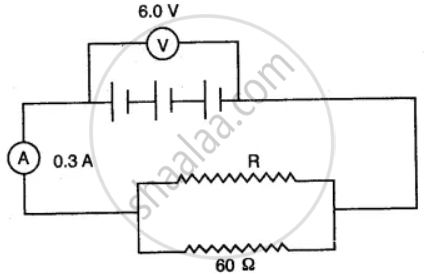
In the figure below, the ammeter A reads 0.3 A. Calculate:
(i) the total resistance of the circuit
(ii) the value of R
(iii) the current flowing through R.
A piece of wire having a resistance R is cut into five equal parts.
- How will the resistance of each part of the wire change compared with the original resistance?
- If the five parts of the wire are placed in parallel, how will the resistance of the combination change?
- What will be ratio of the effective resistance in series connection to that of the parallel connection?
The least resistance obtained by using 2 Ω, 4 Ω, 1 Ω and 100 Ω is:

The diagram above is a schematic diagram of a household circuit. The house shown in the above diagram has 5 usable spaces where electrical connections are made. For this house, the mains have a voltage of 220 V and the net current coming from the mains is 22A.
- What is the mode of connection to all the spaces in the house from the mains?
- The spaces 5 and 4 have the same resistance and spaces 3 and 2 have respective resistances of 20Ω and 30Ω. Space 1 has a resistance double that of space 5. What is the net resistance for space 5.
- What is the current in space 3?
- What should be placed between the main connection and the rest of the house’s electrical appliances to save them from accidental high electric current?
A piece of wire of resistance R is cut into three equal parts. These parts are then connected in parallel. If the equivalent resistance of this parallel combination is R1, what is the value of the ratio R1 : R?
Four resistors each of resistance 5 Ω are connected in parallel. What is the effective resistance?
