Advertisements
Advertisements
प्रश्न
With the help of an appropriate ray diagram, state the sign conventions for reflection by a spherical mirror.
Advertisements
उत्तर
The sign convention for reflection by spherical mirrors is as follows:-
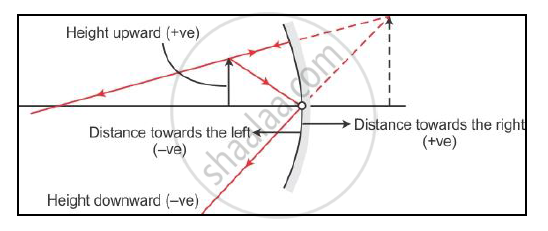
- The object is always placed to the left of the mirror.
- All distances parallel to the principal axis are measured from the pole of the mirror.
- All the distances measured to the right of the origin are taken as positive, while those measured to the left of the origin are taken as negative.
- Distances measured perpendicular to and above the principal axis are taken as positive.
- Distances measured perpendicular to and below the principal axis are taken as negative.
- The focal length of a convex mirror is positive, while that of a concave mirror is negative.
APPEARS IN
संबंधित प्रश्न
To construct a ray diagram we use two rays which are so chosen that it is easy to know their directions after reflection from the mirror. List two such rays and state the path of these rays after reflection in case of concave mirrors. Use these two rays and draw ray diagram to locate the image of an object placed between pole and focus of a concave mirror.
A concave mirror produces three times magnified image on a screen. If the object is placed 20 cm in front of the mirror, how far is the screen from the object.
Fill in the following blank with suitable word:
Parallel rays of light are reflected by a concave mirror to a point called the ..........
A concave mirror ______ rays of light whereas a convex mirror ______ rays of light.
Give two uses of concave mirrors. Explain why you would choose concave mirrors for these uses.
What would your image look like if you stood close to a large:
concave mirror?
A concave mirror cannot be used as:
(a) a magnifying mirror
(b) a torch reflector
(c) a dentist's mirror
(d) a real view mirror
If the radius of curvature of a concave mirror is 20 cm, its focal length is:
Draw a ray diagram to show the formation of the image of an object placed beyond the centre of curvature of a concave mirror. State the position, size and nature of the image.
State two uses of a concave mirror.
In the following diagram. MM' is a concave mirror and AB is an object. Draw on your answer-sheet a ray diagram to show the formation of image of this object.
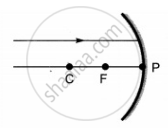
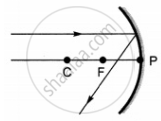
Which of the following ray diagrams is correct for the ray of light incident on a concave mirror as shown in figure?
 |
 |
 |
 |
| A | B | C | D |
Rays from Sun converge at a point 15 cm in front of a concave mirror. Where should an object be placed so that size of its image is equal to the size of the object?
You are provided with a concave mirror, a convex mirror, a concave lens and a convex lens. To obtain an enlarged image of an object you can use either
The image formed by a concave mirror is real, inverted and of the same size as that of the object, the position of the object should be ______.
Between which two points of a concave mirror should an object be placed to obtain a magnification of -2?
