Advertisements
Advertisements
प्रश्न
Complete the following diagrams in figure by drawing the reflected rays for the incident rays 1 and 2 if F is the focus and C is the centre of curvature.
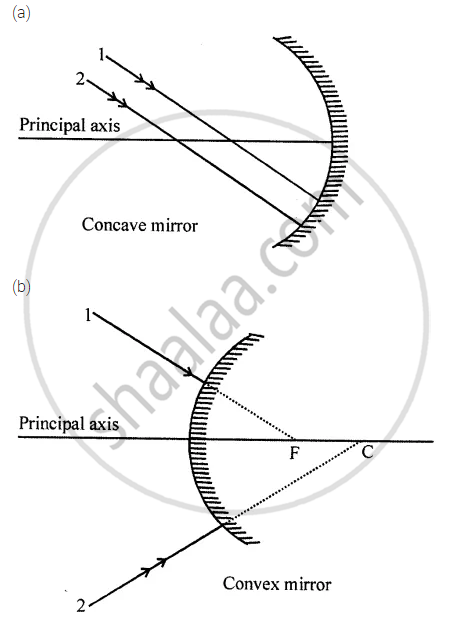
Advertisements
उत्तर

1. Ray passing through F after reflection becomes parallel to the principal axis.
Ray (2) passing through the centre of curvature travels back (retraces its path) i.e. reflected back along its own path.

APPEARS IN
संबंधित प्रश्न
With the help of an appropriate ray diagram, state the sign conventions for reflection by a spherical mirror.
It is desired to obtain an erect image of an object, using concave mirror of focal length of 12 cm.
What should be the range of distance of an object placed in front of the mirror?
Name the type of mirror used in the following situation:
Headlights of a car
Support your answer with reason.
An object is placed at a distance of 12 cm in front of a concave mirror of radius of curvature 30 cm. List four characteristics of the image formed by the mirror.
Draw a ray diagram showing how a concave mirror can be used to produce a real, inverted and diminished image of an object.
An object is placed at a distance of 10 cm from a concave mirror of focal length 20 cm.
- Draw a ray diagram for the formation of image.
- Calculate the image distance.
- State two characteristics of the image formed.
An object is placed at a distance of 10 cm from a concave mirror of focal length 20 cm.
Calculate the image distance.
A student has to determine the focal length of a concave mirror by obtaining the image of a distant object on a screen. For getting best result he should focus
(A) a distant tree or an electric pole
(B) a well-illuminated distant building
(C) well-lit grills of the nearest window
(D) a burning candle laced at the distant edge of the laboratory table
Large ______ mirrors are used to concentrate sunlight to produce heat in solar furnaces.
You are provided with a concave mirror, a convex mirror, a concave lens and a convex lens. To obtain an enlarged image of an object you can use either
